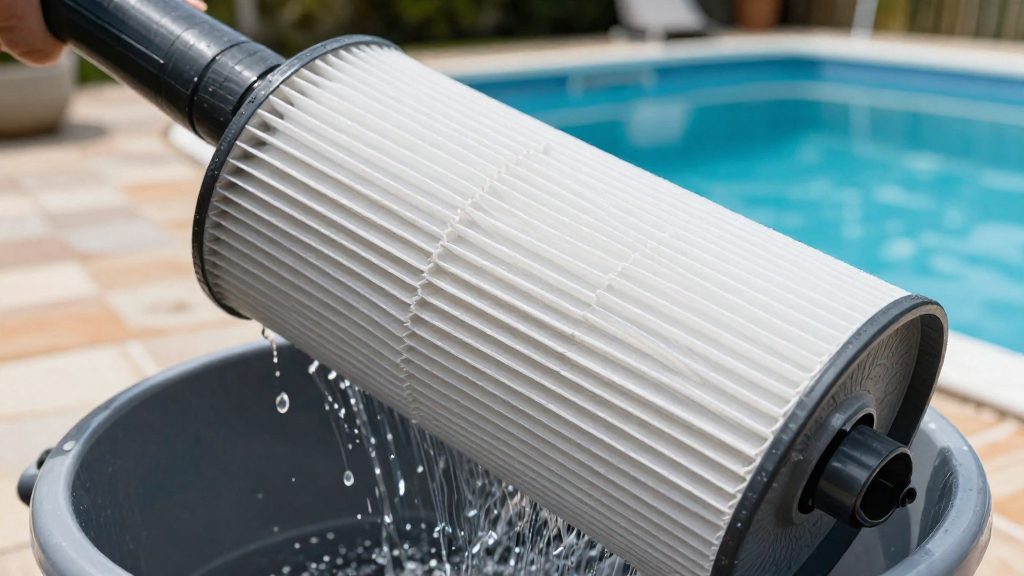
A cartridge filter has no fixed cleaning date. The practical trigger is the pressure gauge: clean the cartridge when the reading climbs about 8 to 10 psi (roughly 55 to 69 kPa) above the reading you recorded on a clean cartridge. One manufacturer gives that range in its support documentation for its cartridge model (2026). Under ideal residential conditions, a specialist guide from PoolDial estimates cleaning every 4 to 8 weeks, but treat that as an estimate and let the gauge decide.
How often should you clean a cartridge filter?
The manufacturer’s support documentation says there is no easy answer. It points to three factors: the length of your pool season, the amount of debris such as leaves and oak catkins in your yard, and the type of pool and filter you have. Two pools with the same volume can therefore need very different service. A pool beside a deciduous tree that drops catkins in spring and leaves in autumn will load its cartridge far faster than a sheltered pool that is covered most of the year.
Flow is the second signal. A specialist guide says cleaning is due when flow drops below the rate you normally get, even if the gauge has not climbed far. Watch the return jets. A weak stream on a pump that was strong last week is a reason to open the filter, whatever the calendar says.
Heavy algae changes the picture completely. The same guide notes that during a severe algae event, cleaning may be needed every few days rather than every few weeks, so keep a log and check the gauge more often until the water clears.
Why does the pressure gauge matter more than the calendar?
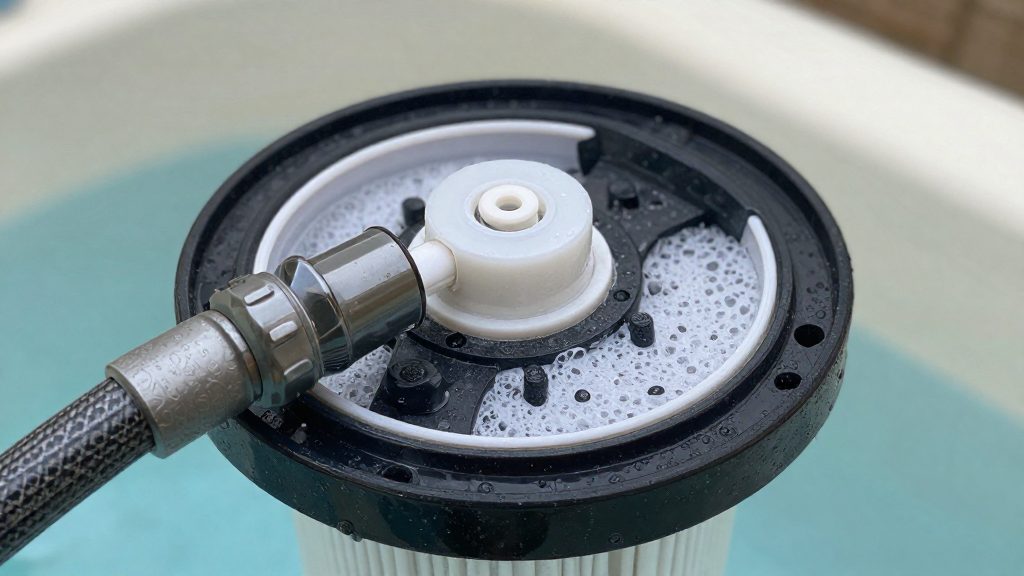
A loaded cartridge resists water flow, so the pump has to work harder and the gauge reads higher. The gauge is therefore a measure of how much debris is trapped, which is what you actually want to know. A calendar cannot see that.
The reading is relative, not absolute. Record the gauge when the cartridge is clean, either right after cleaning or on a new cartridge, and write that number on the filter housing or in your log. Every later reading is compared with it. Take readings at the same pump speed each time, because variable-speed pumps change the pressure you see. If your gauge has a clean-filter arrow, follow the manual for how the manufacturer intends it to be used.
Be careful with numbers from other products. A specialist guide for a different common cartridge model uses a slightly tighter window of 7 to 10 psi above a green-arrow baseline. The principle is the same, but the figure belongs to that model, so use the number in your own manual.
What changes the cleaning schedule?
The main variables are the length of the season, the amount of debris, bather load, and weather. A busy family pool used daily collects more oils, lotions and fine particles than a pool that is used a few times a month, and the guide that discusses soaks treats heavy use as a reason to clean more often.
Water chemistry also matters. Unbalanced water, or water with high levels of organic matter, can encourage algae growth, and algae loads a cartridge faster than dust or pollen does. Keeping the water balanced will not replace cleaning, but it slows how quickly the filter fouls. If you see recurring cloudiness or a quick pressure rise after a warm spell, test the water before you assume the cartridge is the problem.
The official sources consulted do not specify a single cleaning frequency for households in Canada, so the figures in this article should be read as guidance rather than a rule.
When is a chemical soak worth it?
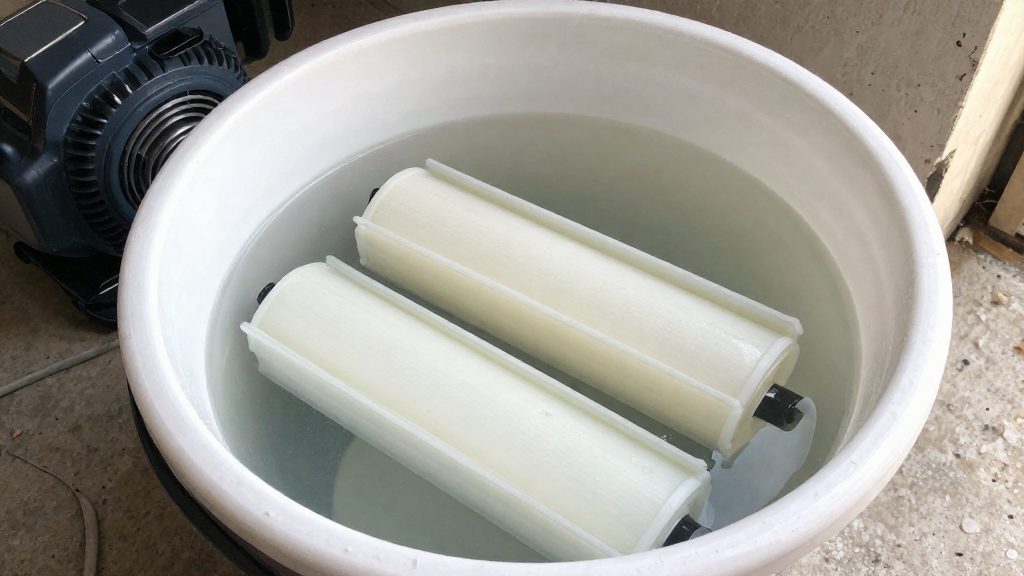
Hosing removes loose debris, but it does not always remove the thin film of oils, lotions and fine particles that builds up between the pleats. A chemical soak is designed for that layer. The specialist guide suggests a soak about every third or fourth routine cleaning on pools with moderate to heavy bather use.
The pressure rule is more useful than the calendar. The same guide says to soak the cartridge whenever the pressure does not return to within 3 psi of baseline after hosing. If that happens, the soak is needed now, not at the next scheduled interval.
Use only a cleaner labelled for cartridge filters, and follow its dilution ratio and soak time exactly. Never mix it with another pool chemical in the same container. The U.S. Centers for Disease Control and Prevention (2025) advises keeping incompatible chemicals apart and in their original labelled containers. That guidance is written for American pools, but the same logic applies at home in Canada, where provincial and municipal rules also govern pool chemicals. Rinse the cartridge thoroughly after a soak before you put it back into service, because leftover cleaner can affect your water chemistry.
How do you clean a cartridge filter safely?
Work with the pump off and the system depressurised. Before you start, gather a garden hose with a spray nozzle, a clean bucket, gloves, eye protection and the cleaner you have chosen. Work in a ventilated area, keep the product’s safety data sheet nearby, and keep food and drink away from the work area.
- Turn off the pump at its switch or timer and wait until it has stopped. Adjust any valves as the manual directs.
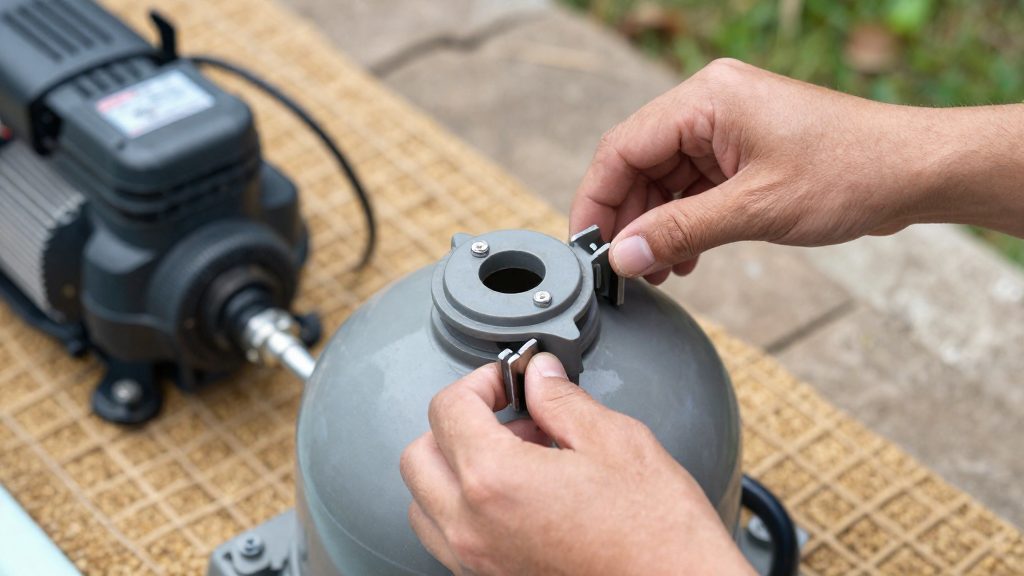
- Open the air-relief valve, if your filter has one, and wait until the gauge reads zero before you open the lid. Opening a pressurised housing can spray water and debris.
- Lift the cartridge out, noting which way it sits. Inspect the pleats and end caps now. If they are torn, bent or separated, skip cleaning and go straight to replacement.
- Hose the pleats with steady water at moderate pressure, working from the clean side as the manual directs. Avoid high-pressure washers unless the manual allows them, because they can bend or tear the pleat material.
- If the pressure did not recover or a soak is due, immerse the cartridge in the diluted cleaner for the time on the label, then rinse until no foam or residue remains.
- Reassemble with the lid o-ring clean, seated and lubricated only with a lubricant the manual approves. Tighten the clamp snugly by hand, and apply any torque figure given in the manual rather than forcing it.
- Restart the pump, open the air-relief valve until water flows steadily, close it, and then read the gauge. If the reading is near your baseline, the cartridge is back in service. If it is still well above it, see the replacement section below.
If the water turns cloudy after restarting, test its chemistry before adding more cleaner. The cause may be the water rather than the cartridge.
When should you replace the cartridge?
Replace the cartridge when cleaning stops restoring performance. The specialist guide advises planning a replacement at the next cleaning trigger if the pressure after cleaning remains more than 6 psi above the new-cartridge baseline. Flow that stays weak after a proper clean is another sign.
Damage is a separate reason to replace it, regardless of pressure. The manufacturer’s support documentation says to replace worn or damaged parts immediately. A torn pleat, a separated end cap or a cracked core lets debris pass through to the pump, so do not run a damaged cartridge while you wait for a new one.
The official sources consulted do not specify a service life in years or cleaning cycles for a typical cartridge. Follow the life stated in your manufacturer’s documentation, and expect it to be shorter where debris or algae is heavy.
What should you check at the start and end of the season?
Once a year, carry out a fuller inspection. The specialist guide recommends a complete cartridge check for pleat deformation, end-cap separation and core damage. It also lists the o-rings, the clamp bolt, the union gaskets and the pressure gauge. In one model’s kit, the guide suggests replacing a seal as a precaution once it reaches about three years old, or sooner if it shows compression set. Check the gauge against a known-good gauge, because a stuck or inaccurate gauge makes every trigger unreliable.
Union gaskets can harden and crack, especially in strong sunlight or heat, so inspect them each year and replace any that look brittle.
Before closing for winter, clean the cartridge fully, let it dry, and store it out of direct sunlight in a cool, dry place. Storing it damp can encourage mould, and a dirty cartridge can carry its load into the next season. Keep the spare cartridge in its packaging so it is ready when you open the pool again.
Frequently asked questions
Can I run the pump with the filter lid off?
No. An open filter can spray water and debris, and the pump can draw air, which may damage components. Turn the pump off before you open the lid.
Does cleaning a cartridge often shorten its life?
The official sources consulted do not specify a cleaning count that shortens life. Gentle hosing is the safer habit, because rough handling is what damages pleats.
Can I use a pressure washer on the pleats?
Only if your manufacturer’s manual allows it. Otherwise, a garden hose at moderate pressure is the safer choice for the pleats.
Is the cleaning frequency the same for every country?
No. The principles of gauge reading and safe handling carry over, but the figures in this article come from American and manufacturer sources, so check your provincial or municipal pool rules for anything legally required.