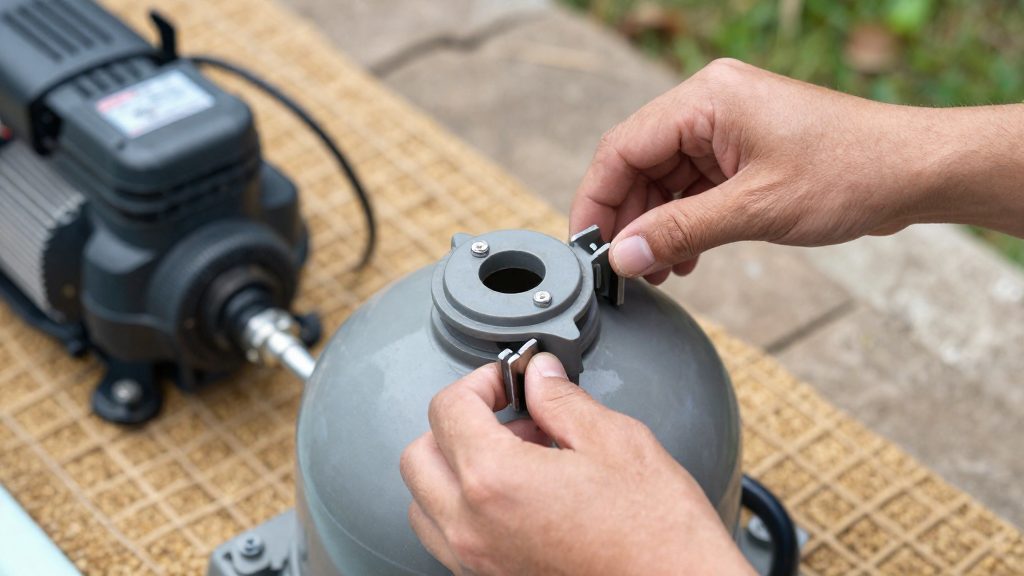
To clean a diatomaceous earth (DE) pool filter, backwash it when the pressure gauge reads about 10 psi above its clean-start level, using the multiport valve in the order Backwash, Rinse, then Filter, with the pump off for every valve change. Then recharge the filter with fresh DE through the skimmer. Plan a deeper clean of the grids and manifold about once a year. Sources differ on the exact pressure trigger and the cleaning interval, so treat the figures below as typical values and confirm them in your filter’s manual.
When does a DE filter need cleaning?
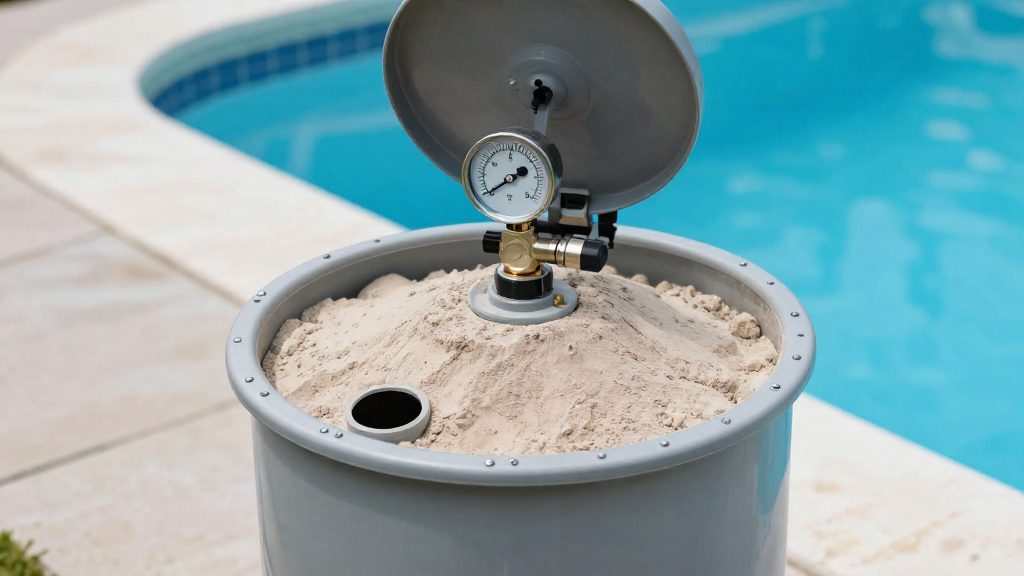
The pressure gauge is your main signal. According to swimmingpool.com, you should backwash a DE filter about once a month during the pool season, and a gauge reading about 10 psi higher than normal is a strong sign that cleaning is due. Poolonomics gives a slightly wider trigger, 8 to 10 psi above the normal reading, and advises recharging the filter every one to three months. The two sources differ on frequency, so the gauge should decide, not the calendar.
For reference, 8 psi is about 55 kPa and 10 psi is about 69 kPa. Record the gauge reading right after a clean start-up with fresh DE in place. That number is your baseline, and every later reading should be compared with it.
Swimmingpool.com also recommends backwashing after the filter has run for 48 hours straight, or after heavy debris or heavy bather load, even if the gauge has not yet reached the trigger.
What do you need before you start?
Gather the following before you shut anything down:
- A fresh supply of DE powder and a clean bucket for mixing the slurry
- A garden hose with a spray nozzle, which Poolonomics recommends for rinsing the grids
- Chemical-resistant gloves, goggles and a dust mask rated for fine particles
- The filter manual, since the valve labels, grid count and DE quantity vary by model
- A spare tank O-ring and O-ring lubricant for the deep-clean stage
Turn the pump off at the breaker box, not only at the pump switch. Swimmingpool.com advises this for safety, and it is the simplest way to confirm the motor cannot start while you work on the filter.
How do you backwash a DE filter, step by step?
The sequence below combines the instructions from swimmingpool.com and a pool retailer’s guide. Run times are typical values. Adjust them if your sight glass shows the water is still dirty.
- Turn the pump off at the breaker. Set the multiport valve to Backwash.
- Turn the pump on and backwash for 1 to 3 minutes, watching the sight glass until the water runs clear. The retailer guide gives 2 to 3 minutes.
- Turn the pump off. Set the valve to Rinse and run the pump for about 30 seconds.
- If old DE still appears in the sight glass, repeat the full cycle. Swimmingpool.com repeats the cycle twice more, first with a 30-second backwash and then with a 15-second backwash, each followed by a short rinse.
- Turn the pump off. Set the valve to Filter.
- Turn the pump on. Add new DE slowly through the skimmer until the gauge returns to its normal operating level.
Never change the valve position while the pump is running. The retailer guide warns that doing so can damage the spider gasket inside the valve, which is a costly repair. Always turn the pump off first, make the valve change, and then restart.
How do you deep clean the grids and manifold?
A deep clean removes the layer of DE and debris that a normal backwash cannot fully lift off the grids. Poolonomics advises doing it about once a year.
- Turn the pump off at the breaker and release the pressure in the tank, following the manual.
- Open the filter tank. Remove the manifold, which holds the grids, and take out each grid.
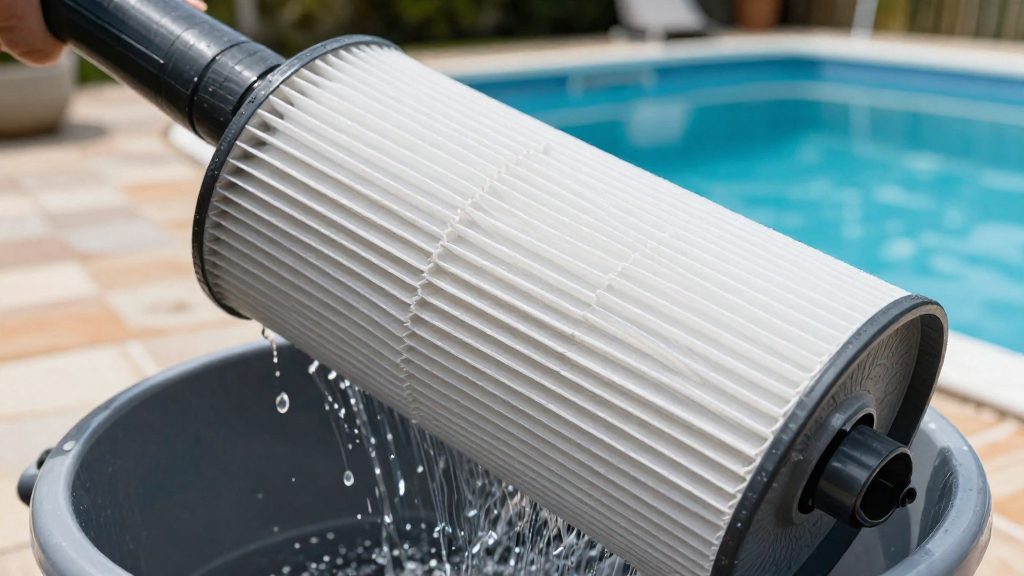
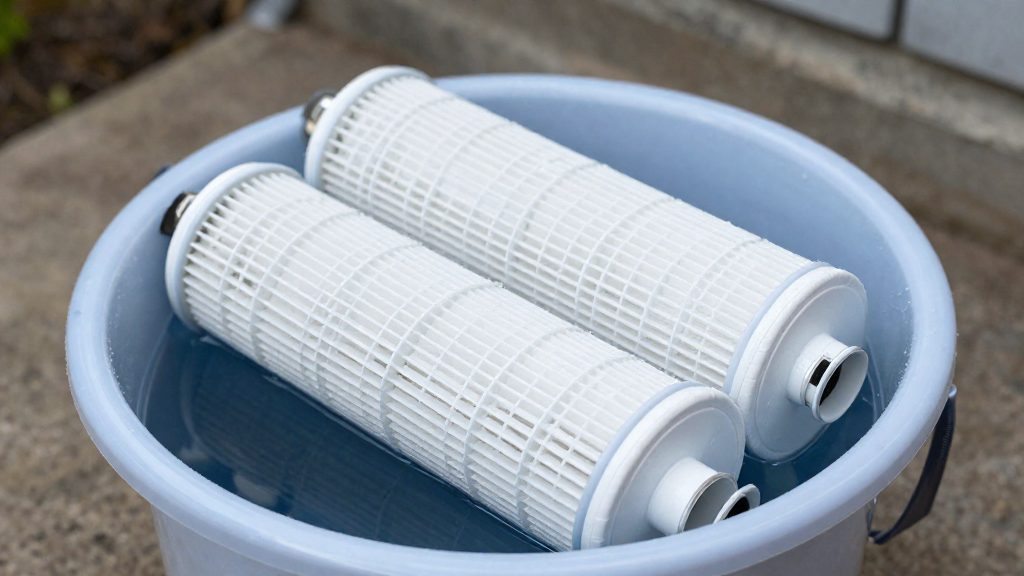
- Hose down each grid with a garden hose and spray nozzle, working from the inside outward so the debris washes away from the fabric. Let the grids dry if the manual advises it.
- Inspect the tank O-ring for cracks, flattening or other deterioration. Replace it if it is damaged. If it is still usable, apply O-ring lubricant.
- Reassemble the manifold and grids, then close the tank.
- Restart the pump and release any trapped air through the air-relief valve, as your manual describes. Watch the gauge, then add DE as a slurry (water mixed with powder) through the skimmer.
If a grid is torn or its fabric has separated from the frame, replace it rather than trying to patch it. The official sources consulted do not specify a replacement interval, so follow the manufacturer’s guidance for your model.
How much DE should you add after cleaning?
Swimmingpool.com estimates that a backwash typically uses about 4 to 6 pounds of DE powder. Poolonomics offers a rule of thumb: divide the filter’s square footage by 5. That source does not make clear whether the result is in pounds or scoops, so do not use it as a fixed dose.
The quantity depends on the grid area and the manufacturer’s specification. The official sources consulted do not specify a pounds-per-square-foot figure, so the manual is the reliable reference. Stop adding DE when the gauge reaches its normal operating level, not when the bag is empty. Adding too much DE raises the pressure and reduces flow without improving filtration.
Why does pressure stay high after cleaning?
If the gauge stays well above its normal reading after a backwash or deep clean, something in the sequence probably did not finish. The sources consulted do not give a full list of causes, but these checks are practical starting points:
- Confirm the valve is in Filter, not Rinse or Backwash, before restarting.
- Check that every grid is seated on the manifold and that the manifold sits correctly in the tank.
- Look for trapped air in the tank, which can make the gauge read high while the filter is still working. Release it as your manual describes.
- Check the tank O-ring. A leaking or misplaced O-ring can let unfiltered water bypass the grids.
If the gauge still does not drop after you have checked these points, stop running the filter at high pressure. Consult the manufacturer’s manual or a qualified pool service technician. Running a DE filter at high pressure can strain the equipment and the grids.
How do you handle DE safely and where does backwash water go in Canada?
DE powder is hazardous if inhaled. Poolonomics advises a chemical mask, chemical-resistant gloves and goggles whenever you handle it. Pour the powder slowly and avoid creating a cloud of dust. Be aware that the crystalline silica content of DE varies by product grade. Check the safety data sheet for the specific product you buy.
The Canadian Centre for Occupational Health and Safety (CCOHS) notes that silicosis, an incurable lung disease, is caused by inhaling dust containing free crystalline silica, and that the only way to prevent it is to control exposure to silica-containing dust. Home use is far lower exposure than an industrial setting, but the same principle applies: keep the powder off your face, keep it out of the air, and do not sweep it up dry.
Backwash water is a separate question. The City of Ottawa, as one example, states on its wastewater education page that backwash from pool maintenance may soak into your own property if it does not affect neighbouring properties, or may be discharged through a connection to the sanitary sewer, which the City advises arranging through a licensed plumber. The same page says pool water must never go to a storm sewer, because chlorine and salt are harmful to aquatic life. If pool water reaches a stream or storm sewer untreated, the City asks owners to report it to the provincial environment ministry and to 311.
These are Ottawa’s rules, not a national standard. Other municipalities set their own sewer-use bylaws, so check your city’s rules before you discharge backwash water. The official sources consulted do not specify how spent DE powder should be disposed of, so follow your municipality’s waste guidance.
Frequently asked questions
Can I use a pressure washer to clean the DE grids?
The sources consulted recommend a garden hose with a spray nozzle. Check the manufacturer’s manual before using anything stronger, since high pressure can damage the grid fabric.
How should I dispose of spent DE powder?
The official sources consulted do not specify a disposal method for spent DE. Check your municipal waste rules, and handle the material with a dust mask to avoid inhaling it.
What if my filter has no pressure gauge?
Without a gauge, you cannot use the pressure trigger. Follow the manufacturer’s manual for the recommended cleaning interval, and watch for reduced water flow or a cloudy pool as signs that the filter needs attention.