For an outdoor pool in Canada, the official sources consulted do not set one national cyanuric acid (CYA) limit for backyard pools. The published ceilings come from provincial and regional rules that mainly cover public pools. Alberta caps CYA at 50 ppm for outdoor public swimming pools, and Halton Region, in Ontario, lists a maximum of 60 mg/L. For a home pool, the working target is the maximum printed in your pool equipment or chlorine manual, and a reading above it is corrected by partly draining and refilling the pool.
Why does an outdoor pool need cyanuric acid?
Sunlight is the main reason. Ultraviolet light breaks down free chlorine quickly, so a pool in full sun loses its sanitizer faster than a shaded or indoor pool. Cyanuric acid binds to free chlorine and shields it from ultraviolet light, which keeps a usable residual in the water for longer and means you add chlorine less often. Indoor pools receive no sunlight to guard against, which is one reason they do not use it, and some local rules forbid it for them.
What is the cyanuric acid limit in Canada?
Alberta has the clearest published figure. Alberta Health Services’ pool approval checklist states that cyanuric acid must not exceed 50 ppm in outdoor swimming pools, and it places that check alongside the Public Swimming Pool Regulation (AR 204/2014) and the Alberta Pool Standards.
Ontario works differently. Ontario Regulation 565 (Public Pools) sets upper and lower limits for water chemistry, including cyanuric acid, in section 7, subsections 8 to 10. Halton Region’s Safe Water Program gives the cyanuric acid maximum as 60 mg/L and says the chemical must not be used in indoor pools or in pools totally or partially covered by a roof. Simcoe Muskoka Health adds that cyanuric acid is no longer permitted in spas, and that amendments to the regulation took effect on January 1, 2025. Check the current consolidated text on e-Laws before you rely on any figure.
These figures do not transfer from one province to another, and they are written for public pools rather than private backyard pools. The official sources consulted do not specify a figure for private pools in other provinces or territories. Ask your municipality or local public health unit which rule applies to your property. In pool water, 1 ppm equals 1 mg/L, so the two units compare directly.
Why is too much cyanuric acid a problem?
Cyanuric acid does not sanitize the water. As it accumulates, it slows the action of chlorine against bacteria and algae, so the same free chlorine reading disinfects more slowly. Adding extra chlorine to chase a high reading can keep the test looking acceptable while the water stays slow to disinfect. Above a certain level, each added increment of cyanuric acid also gives little extra sun protection, so a high reading rarely brings a benefit. The official sources consulted do not give one level at which swimmers face a specific health risk, which is why the maximum in your manual matters.
Clear water does not prove the pool is safe. If the water is cloudy, smells strongly of chlorine, or free chlorine sits below the minimum in your manual, keep swimmers out until the chemistry is corrected and retested.
How do you test cyanuric acid levels?
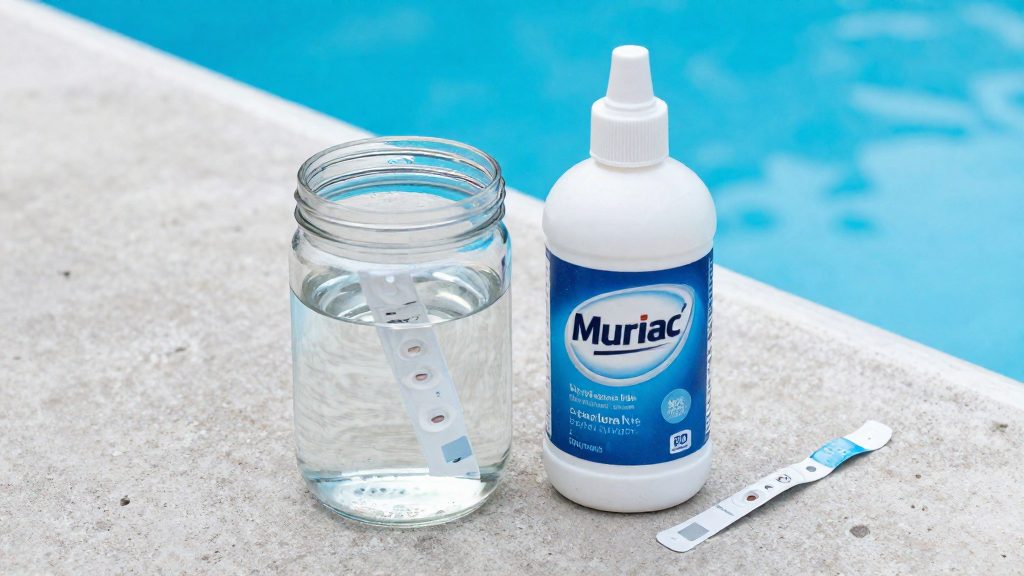
Many multi-test strips include a CYA pad, but strip readings are only rough guides. A liquid test kit or a turbidity-based test gives a more precise result. Follow the kit instructions exactly, because timing and mixing affect the cloudiness that the reading depends on. Take the sample from below the surface, away from skimmers and return jets, and test after filling the pool, after heavy top-ups, and regularly through the season. Record each result, since a steady climb is easier to correct than a high reading found late in the summer. If a reading is at or below your maximum, keep your routine; if it is above, plan dilution before the next heavy chlorine dosing.
When should you lower cyanuric acid, and how?
Lower it when a reading exceeds the maximum in your equipment manual or in the rule that applies to your property. Before correcting anything, find the cause. CYA builds up because trichlor and dichlor products add it with every dose, and it stays in the water. Liquid chlorine and calcium hypochlorite add none. Switching to them stops further buildup, but they lose strength in sunlight faster, so you will dose more often and watch free chlorine closely.
CYA does not break down or evaporate, so the practical fix is dilution. Drain part of the water, refill with fresh water, and retest. The share to replace can be estimated with this formula: (current reading minus target reading) divided by current reading. Reverse osmosis treatment is another route when dilution is impractical; a pool professional can advise on availability and cost.
Do not drain an in-ground pool completely. Groundwater pressure can lift or damage the shell or liner, so limit each drain to the level your pool manufacturer allows. Before discharging chlorinated water, check your municipal bylaw, since many municipalities restrict discharge to storm drains or lawns. Let the free chlorine dissipate or neutralize it as the bylaw permits. When handling chemicals, wear gloves and eye protection, never mix products, and always add chemicals to water rather than the other way around.
How do you keep cyanuric acid in range over the season?
Prevention starts with the chlorine program you choose. A pool that relies on stabilized tablets or granules adds CYA steadily, so it will eventually need dilution. A pool on liquid chlorine or calcium hypochlorite adds CYA only if you add a stabilizer product separately, so track any stabilizer you put in. Pick one primary chlorine source for the season so the CYA added each week is predictable. Use a feeder or floater that the manufacturer approves, and never place stabilized tablets directly in the skimmer basket, where they can concentrate and damage equipment.
At opening, test before adding anything. A pool closed over winter can carry a high CYA reading from last season, and you may need to correct it before restarting the chlorine schedule. Keep the target from your manual beside your test kit so each reading is compared with the same number.
Does a salt water pool need more stabilizer?
Salt chlorine generators make chlorine inside the pool, and most still need a stabilizer to protect that chlorine from sunlight. The official sources consulted do not give one target that suits every salt system, and manufacturers set their own range. That range can differ from a standard chlorine pool and is tied to how the generator operates, so use the figure in your generator’s manual rather than a general table. Do not add stabilizer to a salt pool without a fresh reading, and test with the same kit each time so results stay comparable.
Frequently asked questions
Can I add cyanuric acid to a pool that has none?
Yes, but only in small, measured steps and with a product made for pools. Add it, let it dissolve and circulate, then test before adding more, because overshooting is hard to undo. Follow the dosing instructions on the product label.
Is it safe to swim when cyanuric acid is above the target?
The official sources consulted do not set a swimming ban for cyanuric acid alone. Swim only if free chlorine is within your manual’s range, the pH is in range and the water is clear. Otherwise, wait and retest.
What if my province or territory is not covered here?
The official sources consulted do not list rules for every province and territory. Contact your provincial health ministry, your local public health unit or your municipality to find the rule that applies to your property.