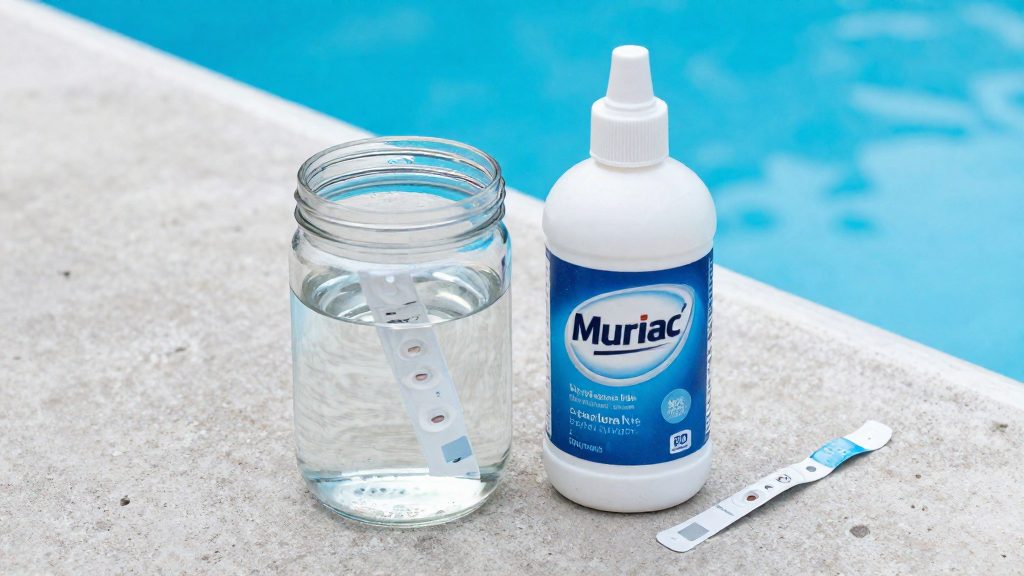
To lower alkalinity in pool water, add a pool-grade acid in small doses while the pump runs, wait, retest, and repeat only if the reading is still high. The acid converts the bicarbonate that makes up most of total alkalinity, but it also pulls pH down, so you will usually need to correct pH afterward. The right dose depends on your pool volume and the product label, and the target you aim for depends on the rules where you live. As a reference, the Government of Newfoundland and Labrador’s public pool manual recommends 80 to 120 ppm of total alkalinity.
Why does high alkalinity cause problems in a pool?
Total alkalinity measures how well the water resists changes in pH. The Newfoundland and Labrador manual describes it as the factor that governs pH stability. When alkalinity is high, pH tends to drift upward and becomes hard to hold in range. Each correction moves it briefly, then it climbs again, so you keep adding chemicals without settling the balance.
In practice, high alkalinity shows up as a pH that will not stay put, water that looks dull or cloudy, and scale deposits on tile, waterline and fittings. Sanitizer also works less predictably when pH is off. Because alkalinity sets the stability of the whole system, it is the first parameter to correct, before you adjust pH or chlorine.
What target range should you aim for?
The Newfoundland and Labrador public pool manual gives a recommended total alkalinity of 80 to 120 ppm and a pH of 7.2 to 7.8. A milligram per litre equals one ppm, so the two units are interchangeable on most test kits. This is a provincial reference for public pools, not a rule that binds every home pool in Canada.
Health Canada’s consumer notices tell owners to test pH, total alkalinity and calcium hardness every day, but they do not give numeric targets. The official sources consulted do not specify a single national range for residential pools. An Ontario proposal posted on October 7, 2021 would set 60 to 180 ppm for public pools, but it was a proposal and not a regulation in force at the time of posting, so check its current status before relying on it. Aim for the range your local health authority or the equipment maker’s documentation gives you. If your reading is only slightly above the top of the range, a small correction is usually enough. If it is far above, plan for several small doses over several days rather than one large one.
How do you lower alkalinity step by step?
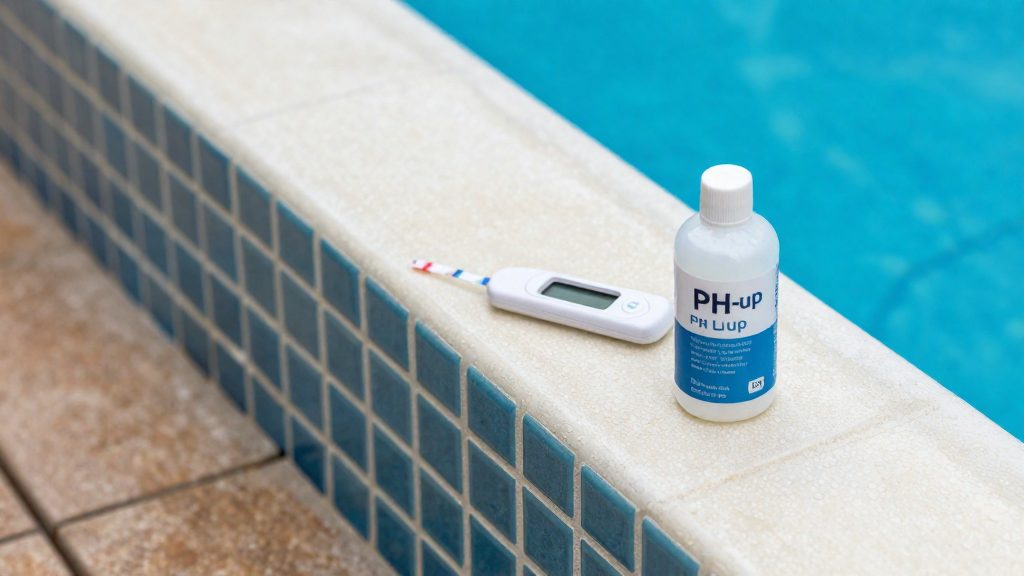
Start with a fresh, accurate reading of total alkalinity, pH, sanitizer level and calcium hardness, using a good-quality kit or a pool and spa dealer, as Health Canada recommends. Then work through the following steps.
- Estimate your pool volume. Multiply length, width and average depth, then apply the factor for your pool’s shape, and use the result to calculate the dose from the label. The label is the reference for dose per volume, and the manufacturer’s documentation overrides any general figure in this article.
- Choose your acid. The next section explains the differences.
- Start the circulation pump and keep it running for the whole dosing and waiting period. Keep swimmers, pets and children out of the water.
- Prepare the acid as the label directs. For liquid acid, pour the measured amount into a bucket of pool water, never water into acid. For granular product, dissolve it first if the label says so, which is common in shallow areas.
- Pour the solution slowly, working around the deep end and keeping it away from metal fittings, ladders and the pool liner. For granular product, broadcast it slowly over the water surface, again following the label.
- Wait for the period the label gives, then test again. Readings taken right after dosing are not representative because the water has not finished mixing.
- If total alkalinity is still above your target, repeat with a smaller dose. Never exceed the label dose in a single application.
- Write down each dose, the date and the reading. This record shows whether the trend is working and helps you spot a recurring source of high alkalinity.
Which acid should you choose?
Two products are commonly used to lower total alkalinity: muriatic acid, which is a hydrochloric acid solution, and dry acid, which is sodium bisulfate. Both work by neutralizing the bicarbonate in the water, and both lower pH as well, so the choice comes down to handling, speed and side effects.
Muriatic acid is liquid, acts relatively quickly and is widely available. It releases fumes and is more corrosive, so it demands more careful handling and ventilation. Dry acid is granular, easier to store and less fuming, but it dissolves more slowly and acts more gently. Repeated use adds sulfate to the water, and high sulfate concentrations can affect some surfaces. The official sources consulted do not give a threshold, so monitor your use and follow the label’s frequency guidance. Whichever you choose, use only a product intended for pools, and never substitute a general-purpose cleaning acid.
When and how do you recover pH after lowering alkalinity?
Because acid lowers both parameters, pH will often fall below the 7.2 lower limit of the reference range after an alkalinity correction. Raise it without adding more alkalinity. Aeration is the usual method: water features, return jets angled upward, or vigorous splashing release dissolved carbon dioxide, which lets pH rise without changing total alkalinity.
Avoid raising pH with products that also add alkalinity, such as baking soda. If pH is far too low and aeration is too slow, a partial drain and refill with fresh water can dilute both values, but the fill water’s own chemistry matters, so test it before you refill.
When should you retest, drain or call a professional?
Retest only after the waiting period on the label, and repeat dosing only while the reading is above your target. If total alkalinity keeps climbing after several careful corrections, the usual suspects are high-alkalinity fill water, a leak bringing in water from another source, or a recent addition of a chemical that raises alkalinity. Test the water you add before blaming the pool.
Partial replacement is worth considering when alkalinity is far above the range, because repeated acid additions would drive pH too low. If the reading does not respond to these steps or the water becomes cloudy, irritating or hard to balance, contact a pool service professional or your local health authority.
What safety rules apply before, during and after dosing?
Wear chemical-resistant gloves, eye protection and long sleeves, and keep your face away from the container when opening it. Work outdoors or in a well-ventilated area, stand upwind of fumes, and do not lean over the bucket. If the label or safety data sheet calls for a respirator, use one. Store acid in its original, labelled, closed container, upright and in a cool, dry place, and keep all pool and spa chemicals away from children and pets, as Health Canada advises.
Never store acid near other pool chemicals, particularly chlorine products, and never mix products together, because the reaction can release toxic gas. Use separate tools for each product. Rinse spills with plenty of water, and follow the first-aid section of the label if the product touches skin or eyes. Keep swimmers out during dosing and until the water has been retested and the label confirms it is safe to use. Dispose of unused product through your municipal hazardous waste program, never down a drain.
Frequently asked questions
Can I use the same bucket for pool acid and other cleaning products?
No. Keep a dedicated, clearly labelled bucket for pool acid only, and never reuse it for chlorine, cleaners or other chemicals, because residues can react with them.
Does a salt-water pool need a different approach to lowering alkalinity?
The basic method stays the same, but the salt chlorinator and its settings can affect pH and sanitizer demand. Check the equipment maker’s documentation before you change dosing or chlorinator output.
Can too much acid damage the pool or its equipment?
Yes. Overdosing can drop pH sharply and may etch some surfaces and corrode metal parts. The official sources consulted do not give damage thresholds, so stay within the label dose and record every addition.