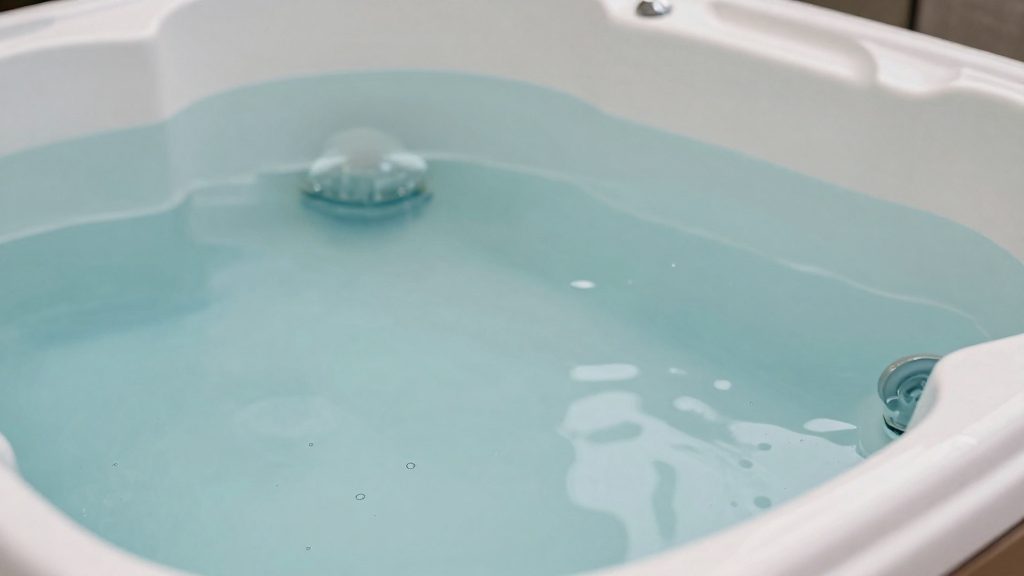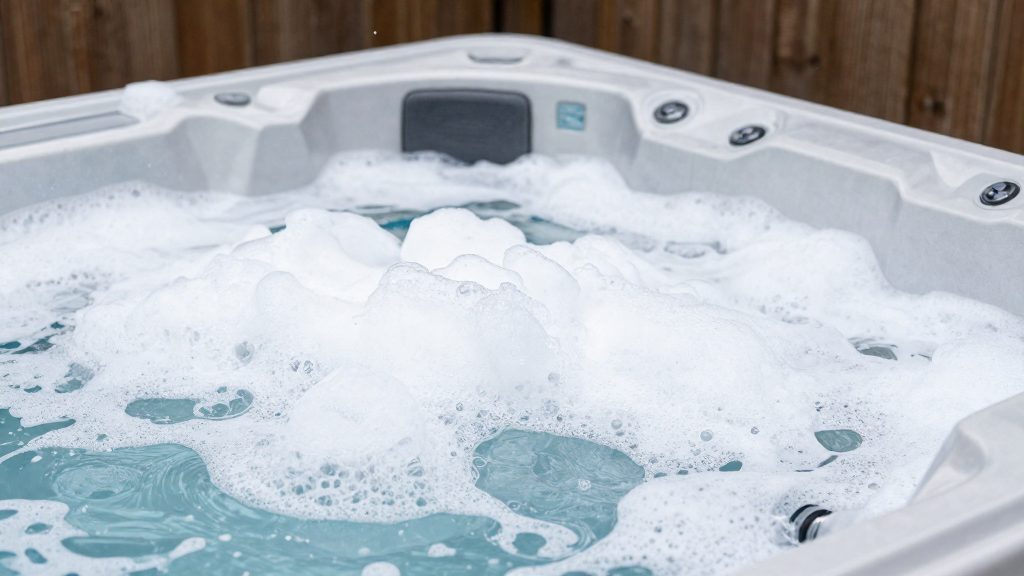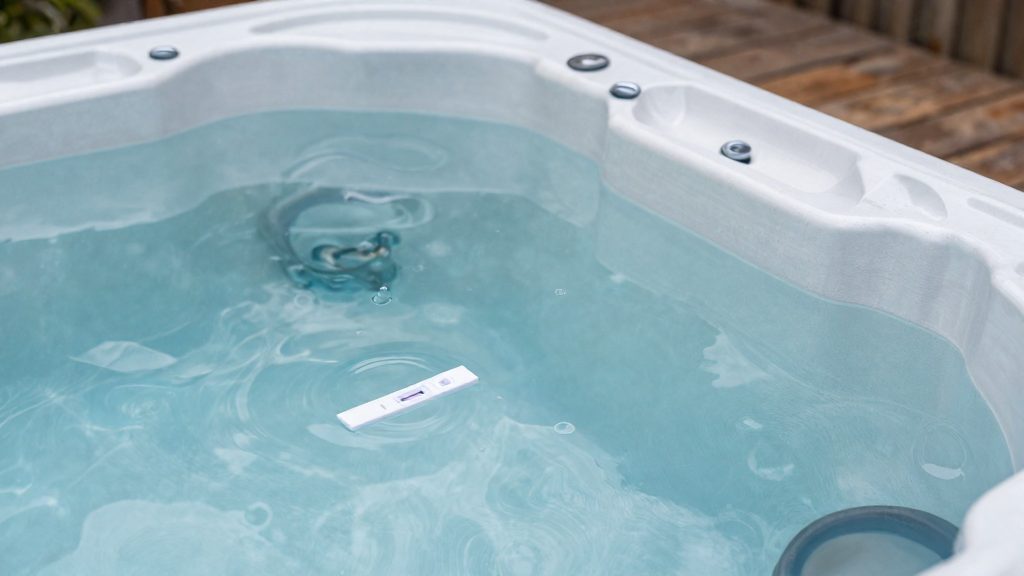
After a party or a busy weekend, a hot tub needs more than its routine weekly check. Bathers bring oils, sweat, cosmetics and other organic matter that consume sanitizer and push pH and total alkalinity off target. The safe sequence is to test first, correct total alkalinity, then pH, then the sanitizer, and to retest before anyone gets back in. Under British Columbia’s residential hot tub guidance, the ideal free chlorine level is 3.0 to 5.0 ppm and the ideal pH is 7.2 to 7.6.
Why does heavy use throw off hot tub water balance?
Each bather adds demand on the sanitizer. Body oils and cosmetics react with free chlorine or bromine, so the residual falls faster than it does with light use, and the reaction products change the chemistry of the water. A hot tub holds a small volume of water, so one busy evening can shift the readings far more than the same load would in a large pool.
Alkalinity deserves particular attention because it acts as a buffer for pH. When total alkalinity drifts low, pH tends to swing from one test to the next, and pH products seem to have little lasting effect. Bromine is a common contributor. A Canadian spa retailer’s support guidance (2018) notes that bromine gradually lowers alkalinity and needs closer monitoring. Heavy use speeds that drift up, so alkalinity should be checked at every heavy-use test.
What ranges does British Columbia guidance set for hot tubs?
HealthLinkBC’s file on residential hot tubs and pools (2025) gives minimum, ideal and maximum values for hot tubs. These are the figures to compare your test results against:
- pH: minimum 7.2, ideal 7.2 to 7.6, maximum 7.8.
- Free available chlorine: minimum 1.5 ppm, ideal 3.0 to 5.0 ppm, maximum 5.0 ppm.
- Bromine: minimum 2.5 ppm, ideal 4.0 to 6.0 ppm, maximum 8.0 ppm.
- Total alkalinity: minimum 80 ppm, ideal 80 to 120 ppm, maximum 120 ppm.
The hot tub part of this guidance has no cyanuric acid row. If your tub uses a stabilized chlorine, rely on the manufacturer’s manual for stabilizer levels rather than on these figures.
How do you test the water before correcting it?
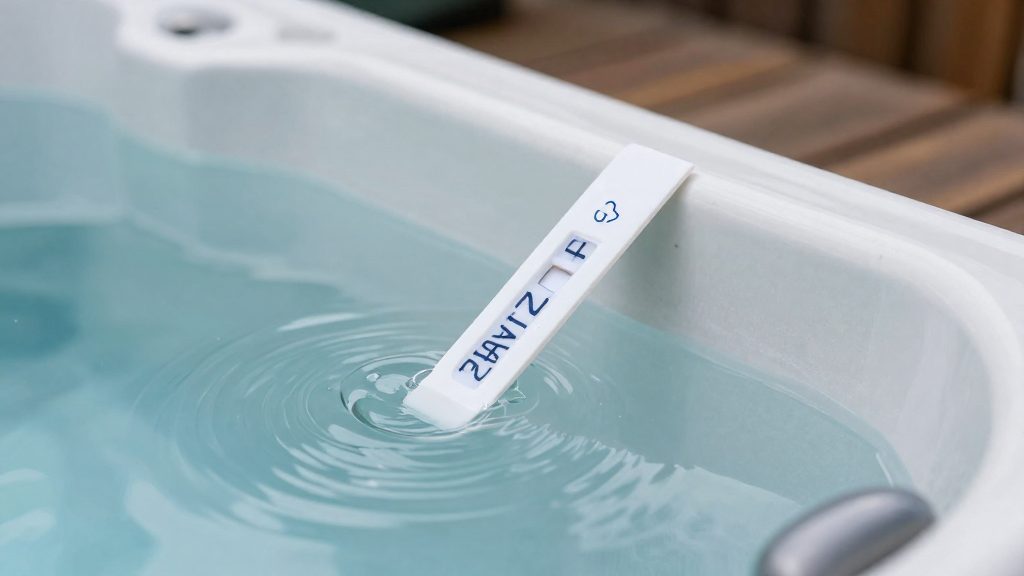
Test before you add anything. Use a kit or strips that read the sanitizer you actually use, plus pH and total alkalinity. Read the result at the time stated on the packaging, because strips give unreliable colours if they are read too early or left too long. If readings contradict each other, repeat the test with fresh strips or a liquid kit before making any adjustment, since a wrong number leads to the wrong dose.
Timing is part of the procedure. HealthLinkBC advises that the chemistry be measured daily, especially during periods of high use. Outside a heavy-use period, the weekly balance recommended in hot tub manufacturers’ guidance remains the baseline. Test after the party, again the next morning, and once more before the first new bather gets in, so you see the trend rather than a single snapshot.
If the results remain unclear after a retest, take a water sample to a qualified pool and spa service provider. They can check the water with more precise equipment and help you interpret the results.
How do you correct alkalinity and pH after heavy use?
Correct in this order: total alkalinity, then pH, then sanitizer. Alkalinity buffers pH, so adjusting pH while alkalinity is off target often fails to hold. Keep to this sequence even when pH looks like the more urgent problem.
- Total alkalinity. If it is above 120 ppm, lower it with a pH-decreasing product. If it is below 80 ppm, use an alkalinity increaser.
- Circulate the water for the time the manufacturer gives, then retest.
- pH. If it is below 7.2, raise it with a pH increaser. If it is above 7.6, lower it with a pH decreaser. Aim for the ideal band, not just the edge of the maximum.
- Sanitizer. Adjust the chlorine or bromine only once alkalinity and pH are stable, then retest.
Follow the product label for every dose and never guess an amount. Add one product at a time with the pump running, and wait and retest between additions so you do not overshoot. Do not mix chemicals together or store them in the same container, and never add them with someone inside the tub. Keep products dry, out of children’s reach, and handle them with gloves and eye protection.
When should you shock the water after heavy use?
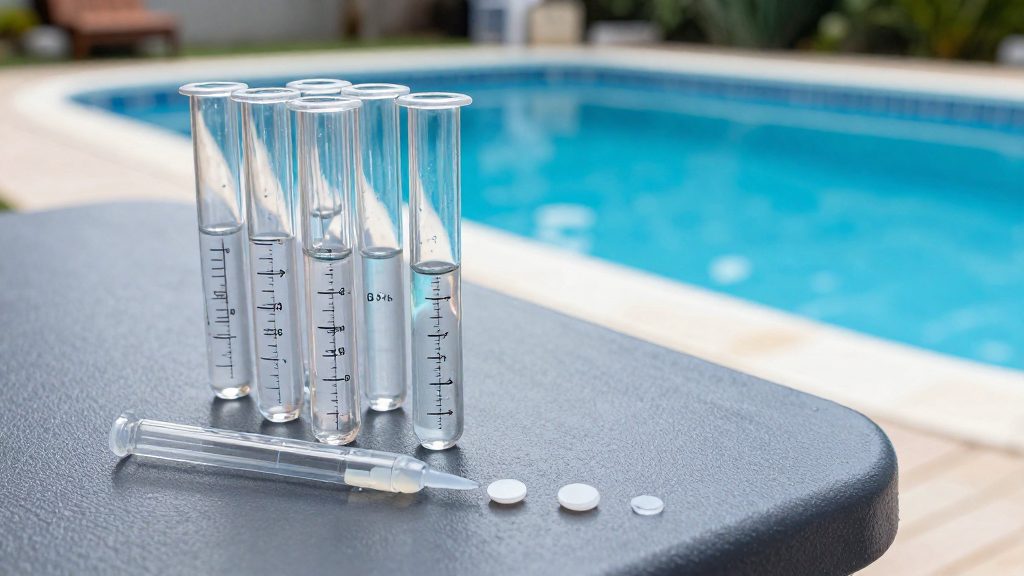
Shock the water after heavy use, after rain or after a water change, as hot tub guidance commonly advises. Shock raises the sanitizer well above normal levels for a short time, which destroys combined chlorine and organic material. Choose a shock that matches your sanitizer. According to the manufacturer’s guidance, either chlorine or non-chlorine shock can be used, depending on the sanitizer in the water, so read the label before buying or using one.
Non-chlorine shock may affect the readings of a chlorine test kit, so after using it, confirm which measure your kit reads. Add shock only once alkalinity and pH are in range, with the cover off and the jets running, and ventilate the area well. Keep bathers and pets out until retesting is complete.
When is it safe to get back in?
Do not re-enter until test results show the sanitizer has dropped back into the required range. The BC guidance is explicit that the tub should not be used until the chlorine level has returned to the required range. Before entering, confirm the following:
- The sanitizer reading is within the range listed above for your system.
- pH and total alkalinity are back within their ranges.
- The waiting period on the shock product’s label has passed. If the label and the retest call for different waits, use the longer one.
If anyone reports eye, ear or skin irritation after using the water, stop use and retest before anyone else enters.
When should you drain and refill?
Top-ups do not fix a hot tub that is consistently out of balance. The BC guidance advises draining and cleaning when there are complaints of eye, ear or skin irritation, a fecal or vomiting incident in the water, or disinfectant levels that could not be kept in range.
Beyond those events, a complete water change at least every 3 months is the interval recommended by a Canadian spa retailer (2018), and heavy use calls for more frequent changes. In a small hot tub, replacing all the water is often easier than repeated shocking, a point HealthLinkBC also makes (2025).
When refilling, clean the shell and filter as the manufacturer’s manual describes, refill, then work through the whole procedure again: test, correct alkalinity, correct pH, adjust the sanitizer, retest, and only then allow use. The BC file also addresses risks such as Legionella, which is one reason disinfectant levels should not be allowed to drift between heavy-use sessions.
Frequently asked questions
What should I do if someone feels unwell after using the hot tub?
Stop using the tub and keep others out of the water. Contact HealthLinkBC for health advice, or seek urgent care for severe symptoms. Water maintenance does not replace medical advice.
Is a cloudy hot tub after a party always a chemistry problem?
Not always. Cloudiness can also come from the filter, body oils or debris. Check and clean the filter as the manufacturer’s manual describes, then retest the water before deciding whether it needs treatment.
Do these British Columbia figures apply if I live in another province?
Not as a legal requirement for you. Other provinces and municipalities can set different rules, so check with your local public health authority and follow your manufacturer’s manual.