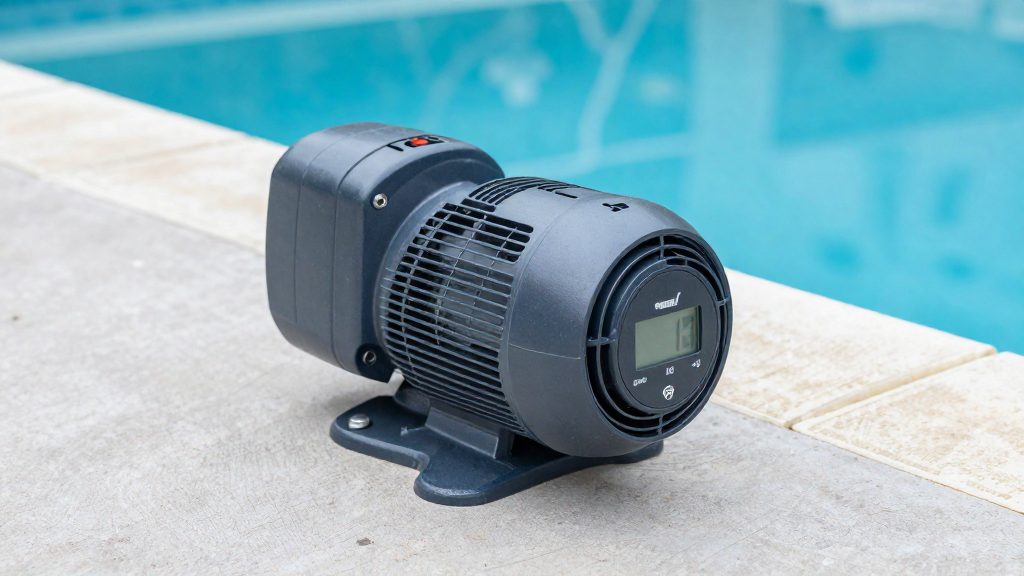
Most residential pools need their pump to run about 8 to 12 hours a day, long enough for the entire pool volume to pass through the filter at least once. According to Swimming Pool.com (Pool Corporation), that run time does not have to be continuous: it can be split into sessions, such as one block in the morning and another in the evening. The right figure depends on pool size, pump flow, temperature and how heavily the pool is used, so the calculation below is the best way to set your own schedule.
How many hours a day should a pool pump run?
The 8 to 12 hour range is a common starting point, not a legal requirement for a home pool. Within that range, the goal is simple: complete at least one full turnover every day. The Swimming Pool.com example of three hours in the morning and five in the evening shows that the daily total drives circulation, while the timing is a matter of convenience. A Markham, Ontario supplier of pool salt makes the same point for saltwater pools, recommending non-consecutive slots that together cover eight hours (Canada Salt Group Limited).
How do you calculate turnover time?
Turnover time is the pool volume divided by the pump’s actual flow. The result is in minutes: turnover time (minutes) = pool volume (gallons) ÷ flow rate (GPM). Swim University uses the same formula. For a 20,000-gallon pool moving 40 GPM, the calculation is 20,000 ÷ 40 = 500 minutes, or about 8.3 hours.
Canadian owners usually work in litres. Twenty thousand US gallons is about 75,700 litres, and 40 GPM is about 151 litres per minute. Dividing 75,700 by 151 gives roughly 501 minutes, which is the same 8.3 hours.
Swimming Pool.com also gives a quick rule of thumb: divide the pool volume by 8 to get the gallons per hour the pump must move. For 20,000 gallons, that is 2,500 gallons per hour, or about 42 GPM, which matches an 8-hour turnover. One Canadian pool-salt supplier words the same rule as gallons per minute, but the arithmetic only works as gallons per hour, so check any result against the formula above.
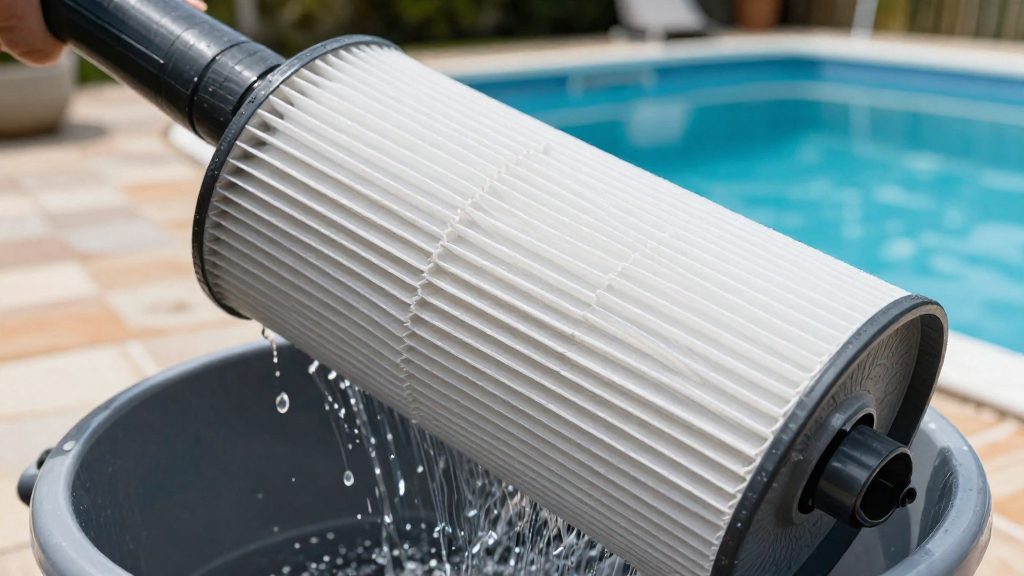
Use the flow the pump actually delivers, not the maximum printed on the label. A dirty filter, a full skimmer basket or restricted pipes all lower real flow and lengthen the turnover. Clean these first, then check the performance chart for your model in the manufacturer’s documentation.
Why does heat change the run time?
Swim University offers a simple baseline called the 10°F rule: run the pump one hour for every 10°F (5.6°C) of air temperature. At 80°F (about 27°C) that gives 8 hours, and at 100°F (about 38°C) it gives 10 hours. Above 90°F (32°C), the same source suggests adding 2 more hours.
The same publisher also says that high heat or heavy-use periods call for 12 to 16 hours. The two figures fit together. The 10°F rule is the everyday baseline, and the 12 to 16 hour range applies to the hottest days or to periods with many swimmers. On a 100°F day, the baseline of 10 hours plus the extra 2 hours gives 12 hours, the low end of that range. Going to 16 hours is not a default. Reserve it for exceptional use, and confirm that the water stays clear and the chemical levels hold.
Because the 10°F rule is a rule of thumb from a single publisher, treat it as an estimate and adjust it using your water tests.
How do variable-speed pumps change the schedule?
Swim University describes a common variable-speed pattern of about 12 hours a day: 3 to 4 hours on high speed for chemical circulation and debris removal, then 8 to 9 hours on low speed for basic filtration. This keeps the daily total inside the 8 to 12 hour range.
The Hayward HCP3000 series manual sets the threshold differently. It recommends filtering all the water in the pool at least once every 24 hours, and it tells owners to check local requirements for the minimum turnover rate. Its key scheduling point is the trade-off: running at a lower speed may require running for longer to meet the turnover target. The 24-hour figure is the manual’s minimum, while the 8 to 12 hour range is a typical operating window, so the two are compatible. Look for the speed and run-time guidance in your own model’s manual before choosing a pattern.
When should the pump run?
Overnight is the usual advice for chemical treatment. Swimming Pool.com advises shocking the pool at night so sunlight does not break down the chemicals, and running the pump afterward. For routine chemicals, the same source says to run the pump immediately after adding them so they disperse. Canada Salt Group Limited also recommends overnight running for saltwater pools.
Safety comes first when dosing. Keep swimmers out of the water until the product label and your test results say it is safe to return. Add each product as its label directs, and never combine different chemical products in the same container or in a skimmer or pump basket. Dosing with the pump running is the simplest way to avoid concentrated pockets of chemical near the pool surface.
How should you run the pump in cool weather?
Swim University gives a clear step-down for cold conditions. In mild weather, when temperatures stay above 40°F (4°C), you can cut back to 4 to 6 hours a day. When temperatures approach or drop below 40°F (4°C), run the pump continuously until they rise again. Moving water is less likely to freeze in pipes, but this does not replace the manufacturer’s freeze-protection guidance for your equipment.
When you close the pool for the season, follow the manufacturer’s shutdown and winterizing procedure for your pump and filter. The official sources consulted do not give a closing schedule for a particular model, so the manual is the reference.
Do Canadian public pool rules apply to my backyard pool?
Not directly. Ontario’s Regulation 565 (Public Pools) and Alberta’s public pool standards set operating requirements for public pools, including turnover requirements that vary by pool type. The e-Laws page for Regulation 565 could not be read in full, so no turnover figure from it is quoted here. For Alberta, check the current regulation and standards directly rather than relying on older documents or secondary articles. If you operate a public or semi-public pool, confirm the exact requirement with your local public health authority before you change any schedule.
What signs show the circulation is too short?
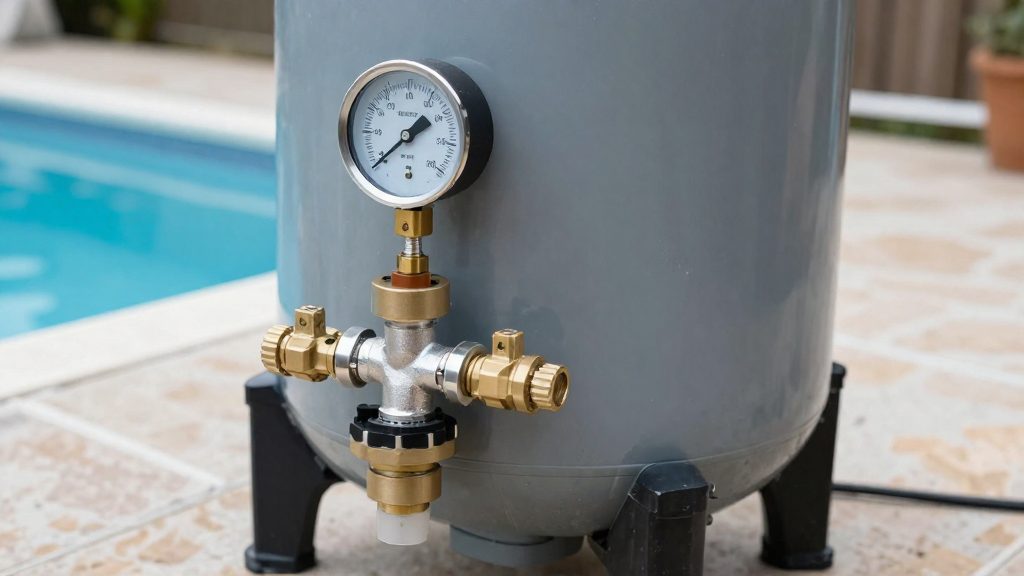
Cloudy water, algae, weak return jets and a pool that needs more chlorine than usual are signs that circulation is not keeping up. Swim University suggests running longer in those cases and says up to 24 hours may be needed while treating cloudy water or algae. Treat that as a temporary measure. Once the water clears, return to your normal schedule and retest. Clean the skimmer and pump baskets, and check the filter pressure gauge as the manufacturer describes.
Before you open the pump lid, basket or any part of the equipment, switch the pump off at its breaker or control. Never let a pump run dry, because it can overheat and damage its seal. Make sure the pump circuit has ground-fault protection, and have a licensed electrician check any wiring that looks damaged or unprotected.
Frequently asked questions
What should I do if a power outage stops the pump for a day?
Restart the pump once power returns. Check that the basket is clear, that the water level is adequate and that water is returning to the pool normally. Retest the water before swimming, because chemical levels may have shifted.
Can I run the pump on a timer?
Yes. A timer or the pump’s built-in schedule can set the run blocks you choose. Re-check the schedule when the weather changes, especially at the start and end of the season.
Does this schedule apply to a spa or hot tub?
Not directly. Spas have their own circulation and filtration requirements, so follow the spa manufacturer’s documentation rather than pool figures.