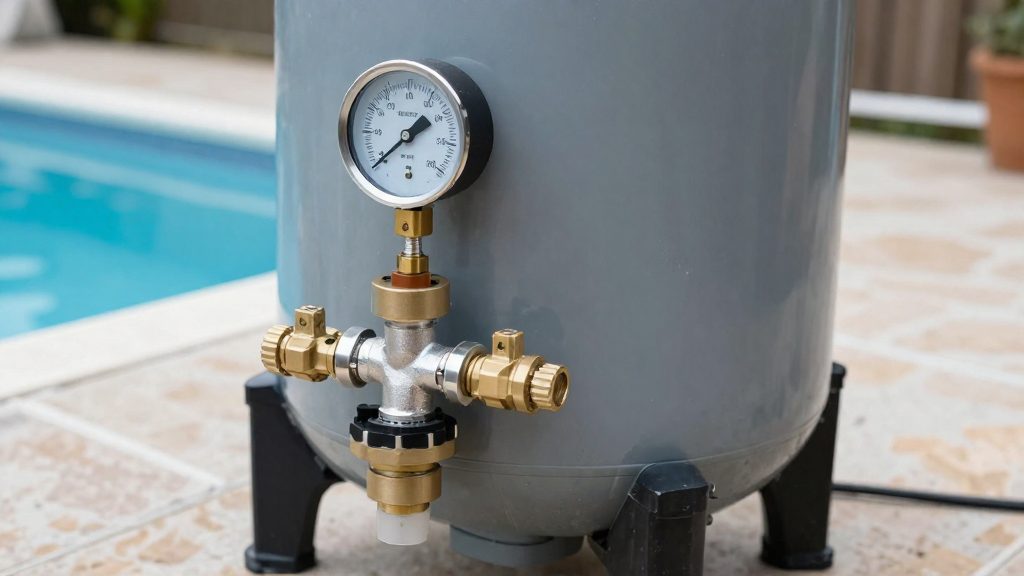
There is no fixed number of days between backwashes. Backwash your sand pool filter when the pressure gauge reads about 8 to 10 psi (roughly 0.55 to 0.69 bar) above the reading you recorded when the filter was clean. That range appears in the sand filter manual consulted for this article and is commonly repeated in retailer guides, but the figure in your own manual takes precedence. Check the gauge at least once a week during the swimming season, and backwash when the threshold is reached rather than when a calendar date arrives.
Why does the pressure gauge beat a fixed schedule?
A sand filter traps debris in the bed of sand. As the bed fills, water meets more resistance, the pump works harder, and the gauge reads higher. A calendar cannot follow this process, because bather load, leaves, pollen, wind-blown dust and the number of hours the pump runs all change how quickly the bed loads. A filter backwashed on a fixed schedule is either cleaned too early, which wastes water, or left dirty too long, which reduces circulation and clarity. The gauge measures the actual condition of the filter.
A second sign is weaker return flow. If the water coming back through the jets feels weaker than usual, the sand is probably loaded, provided the pump runs at its normal speed and the skimmer and pump basket are clean. Treat pressure as the main indicator and flow as a confirmation.
How do you set the clean baseline?
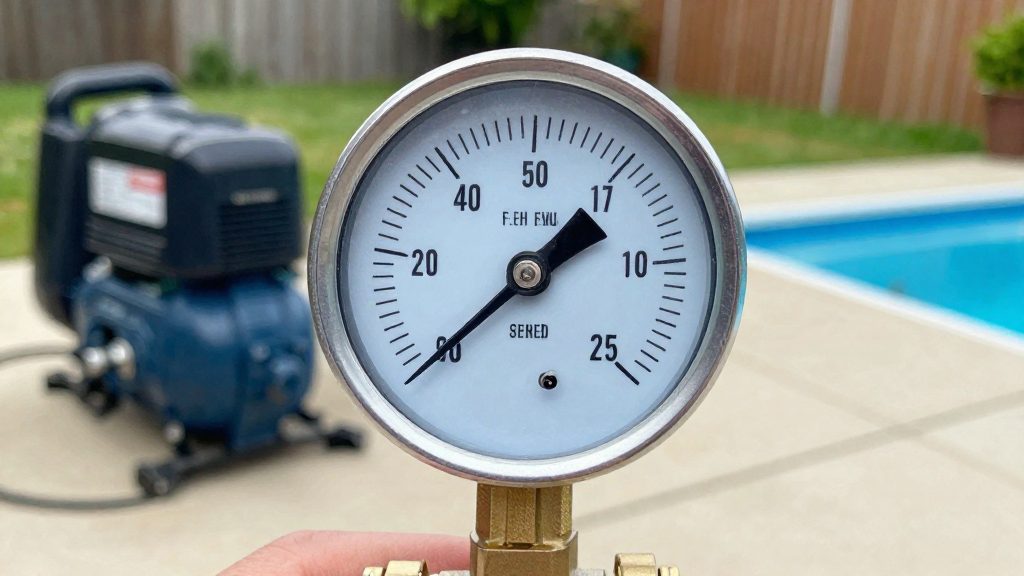
The threshold is only meaningful when it is measured from a known starting point. Immediately after a complete backwash and rinse, return the valve to filter, run the pump at its normal speed, and wait a few minutes for the reading to settle. Write down the pressure, the date and the pump speed. Variable-speed pumps make this step important: the same filter reads different pressures at different speeds, so the baseline is valid only at the speed you normally use.
Once you have the baseline, add the rise to it. If the clean reading is 12 psi, backwash when the gauge reaches about 20 to 22 psi. If your manual gives a smaller rise, use that figure instead. Some sand filter manuals specify a lower trigger, around 6 to 8 psi, for certain models, so do not copy a number from a different filter. Record a new baseline after every backwash, because the reading after cleaning is the true starting point.
How long should backwash and rinse take?
For most sand filters, manufacturers’ guidance is to backwash for about 2 to 3 minutes, or until the water in the sight glass or waste line runs clear. Then run the rinse setting for 30 to 60 seconds before returning to filter mode. The rinse settles the sand bed and clears the dirty water left in the valve and waste line. Follow this sequence:
- Turn the pump off before you touch the valve. The handle can be under pressure, and turning it with the pump running can spray water or damage the seals. Keep your hands dry and do not work near the pump motor while it is connected to power.
- Set the valve to backwash, turn the pump on, and run it for 2 to 3 minutes or until the sight glass clears.
- Turn the pump off, set the valve to rinse, and run it for 30 to 60 seconds.
- Turn the pump off, set the valve to filter, and restart. Check that the gauge has dropped back close to your baseline.
A new plaster pool releases fine plaster dust that loads the sand quickly. In that case the manual may call for a longer backwash, and you should repeat the cycle until the water runs clear. Do not extend the time beyond what the manual describes, because excessive backwashing wastes water.
When is backwashing too frequent?
Backwashing more often than needed uses water and removes some of the fine material that helps the sand bed trap small particles. Do not backwash simply because the water looks slightly cloudy. Cloudiness often points to water chemistry rather than filter loading, so test the water first. Adjust sanitiser, pH or clarifier as needed, then check the gauge. If the gauge has not reached your threshold, the filter is probably working as intended and does not need cleaning.
Where can backwash water go?
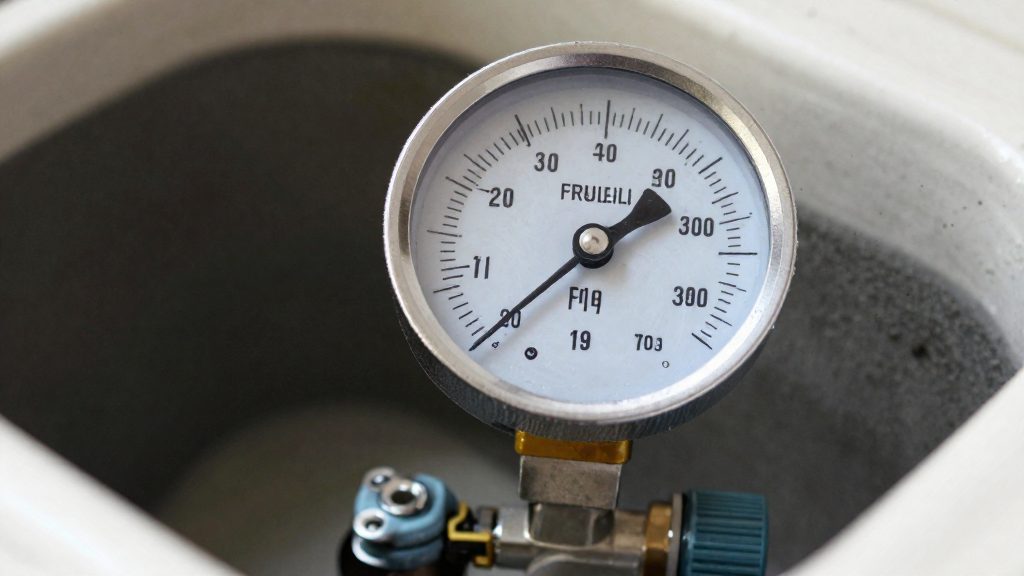
Backwash water carries dirt and sanitiser, and the rules for where it can go come from your municipality, not from the filter manual. Rules vary from city to city, so check your local sewer or pool bylaw before the first backwash of the season.
The City of Winnipeg’s guidance, last updated June 28, 2023, shows the kinds of conditions that are common. Pool water and filter backwash may go to the household wastewater sewer, or onto your lawn if the water stays on your property until it evaporates or soaks into the ground. Discharge to a catch basin requires a licence, and backwash must be filtered and dechlorinated first. Discharge into a manhole, a neighbouring property, a sidewalk or a waterway is prohibited. The City of Ottawa and the City of Mississauga also publish pool discharge guidance, and Mississauga’s pool owner guide notes that discharging contaminated water into a storm drain is prohibited under its bylaw.
In practice, secure the hose so it cannot slide off a driveway, keep the water away from ponds, and avoid directing it toward a garden bed you are growing food in. If your bylaw is unclear, ask the municipality before backwashing.
What if pressure stays high after backwashing?
If the gauge does not fall close to the clean baseline after a full backwash and rinse, or if flow stays weak, the problem is probably in the filter rather than the schedule. Check these items in order, with the pump off: the valve is fully in the filter position; the waste line or sight glass is not blocked; the skimmer and pump basket are clear; and the return valves are open. Then look at the lateral assembly, which sits at the bottom of the tank and can clog or break.
If none of these steps restores normal operation, the sand may be exhausted or clogged with fine debris and scale. The manual gives the correct sand type, quantity and fill method, and it should be followed exactly. Sand filter tanks are heavy and under pressure when running, so isolate the pump and depressurise the system before opening the tank. Do not lift a full tank or sand bag alone.
Frequently asked questions
Can I backwash a sand filter in winter?
Backwash only during normal season use. For winter closing, follow the manufacturer’s steps, because water trapped in the filter and valve can freeze and crack parts.
Can a high gauge reading come from something other than dirt?
Yes. A partly closed valve, a restricted return line, or a pump running faster than your baseline speed can all raise the reading. Check these and reset the baseline before you backwash.
What should I do if the sight glass never clears?
Stop the pump, confirm the valve is set to backwash and the waste line is clear, then review the troubleshooting section of your manual. If the water still does not clear, have a pool professional inspect the filter before you keep running it.