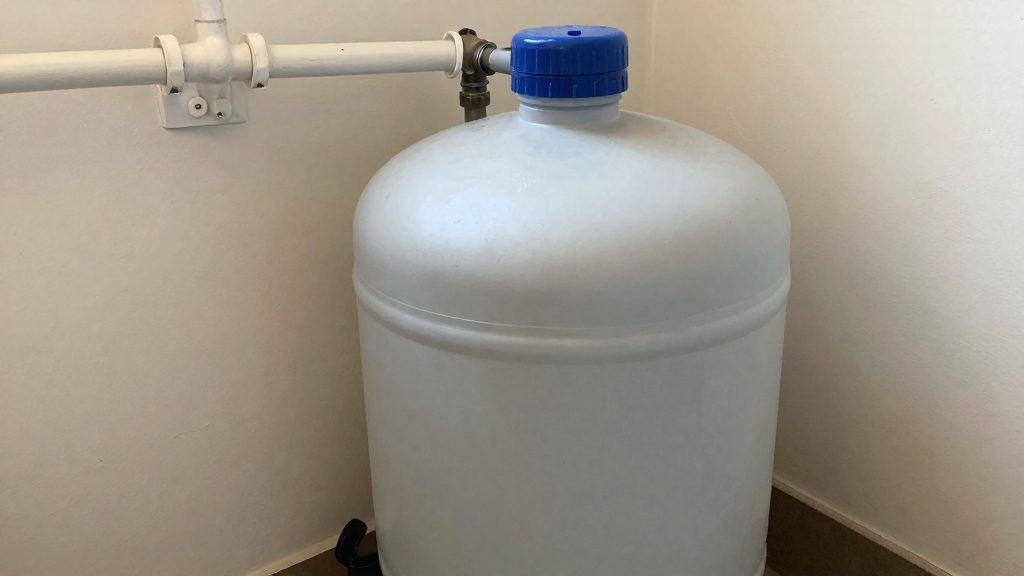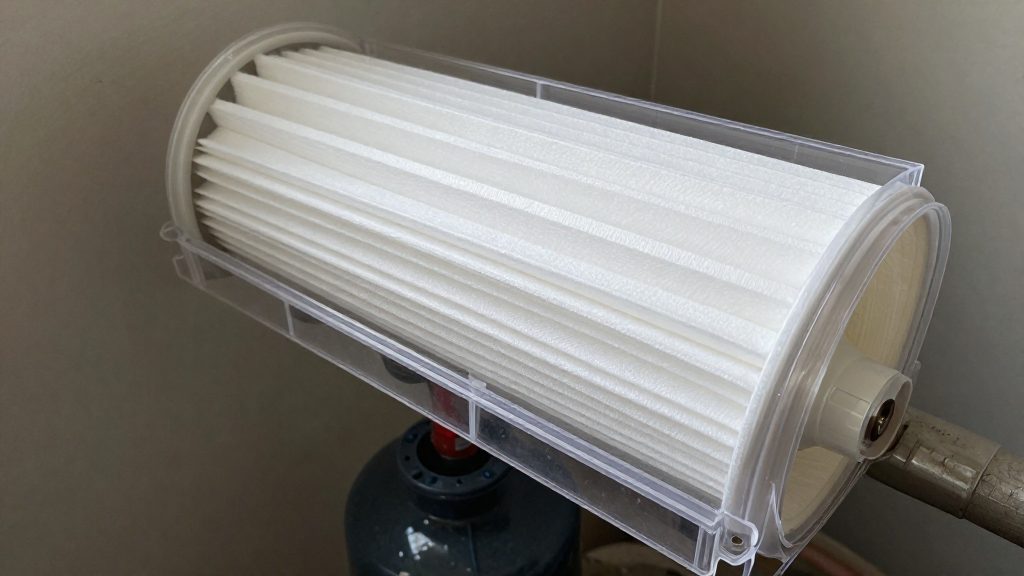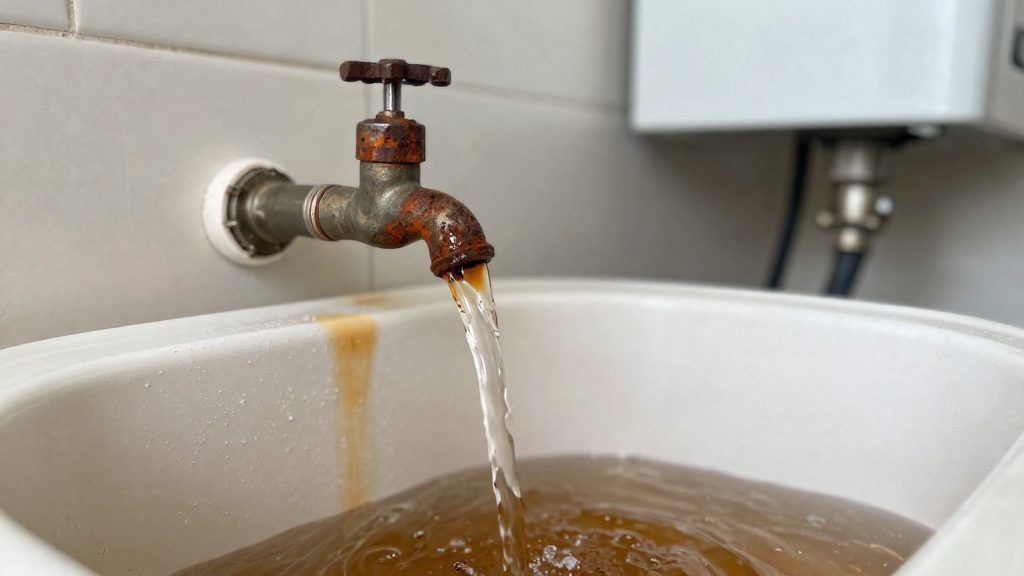
A iron removal filter for well water in your house is a point-of-entry unit installed where the water enters the home, sized to your well’s iron level and your household’s peak water use. Health Canada sets an aesthetic objective of 0.1 mg/L (100 µg/L) for total iron in drinking water, a target set for taste and appearance rather than health. Certified residential units for iron are available in Canada, but the right choice depends on test results, not on the product label.
Why does iron in well water matter?
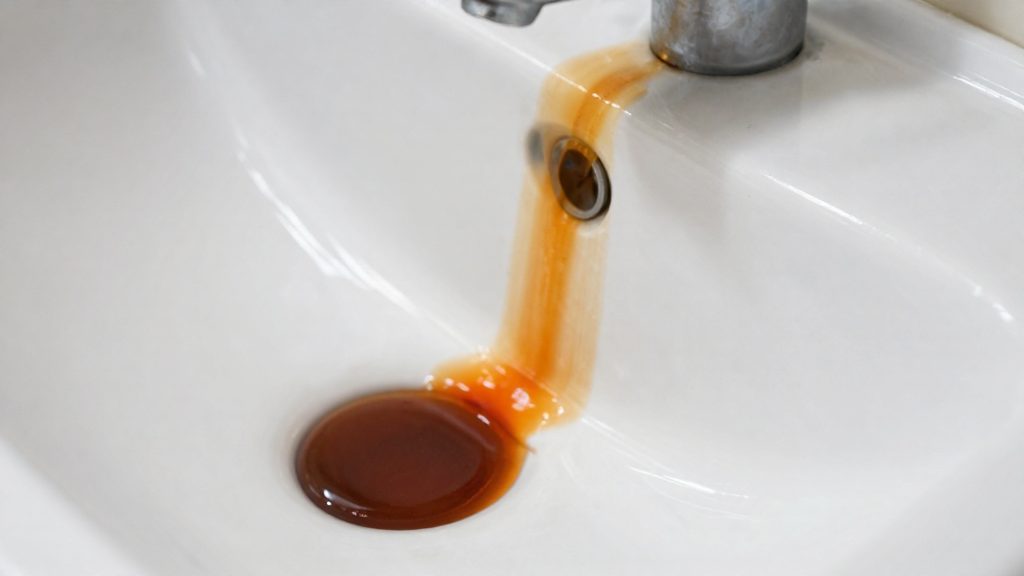
Iron is common in groundwater, and it causes problems long before it becomes a health concern. According to Health Canada (2024), iron above about 0.17 mg/L is likely to give water a metallic or bitter taste, and above about 0.03 mg/L it can discolour water. Staining of sinks, tubs, toilets and laundry is also possible, which is often the first sign a homeowner notices: orange or brown marks that return after cleaning.
From a health standpoint, the picture is reassuring but not a reason to ignore the problem. Health Canada notes that drinking water supplies less than 10% of total daily iron intake, and that the most sensitive effect of high short-term intakes is gastrointestinal upset. Iron is therefore mainly a question of water quality and equipment protection.
Iron can also feed iron bacteria. Where iron is present, these organisms can grow in pipes and well components and leave slimy deposits, so a dark slime or a recurring film in the toilet tank points to a bacterial test, not only an iron test.
What does the 0.1 mg/L objective mean for your well?
The 0.1 mg/L figure is an aesthetic objective, not a maximum acceptable concentration. In practical terms, it is a target for keeping water clear, tasting normal and leaving fixtures unstained. A reading above it does not by itself mean your water is unsafe to drink, but it does mean you should act, because the staining and taste problems will continue and can damage plumbing appliances over time.
Health Canada advises that private well owners test their water regularly, as municipal systems do, and add treatment when needed. Testing is most useful when the water changes: if the water looks orange, tastes metallic or stains after a period of heavy use or after a nearby well is serviced, test at the tap.
The official sources consulted do not specify a single testing interval for private wells. Your regional public health authority can tell you which parameters to test for and how often, and it is worth asking, because the answer depends on your aquifer and your neighbourhood.
How do you test well water for iron?
Start by testing raw water, meaning water taken before any treatment. Use an accredited laboratory, follow its sampling instructions exactly, and ask for total iron, because dissolved and particulate iron behave differently and total iron is the value Health Canada compares with the objective. Sampling from a kitchen tap that has a sediment filter or softener upstream will give a misleading result.
Ask the laboratory to include related parameters. Bacteria should be tested for as well, since iron bacteria and other organisms do not show up in an iron test. Manganese is often found alongside iron, and the official guidance on iron notes that iron removal generally also improves manganese removal, but you should still test for manganese directly rather than assume it has been handled.
Record the date, the sampling location and any visible signs such as colour, sediment or odour. These notes are useful for the technician who will size your filter, and for comparing results after installation.
Which iron removal filter suits your well?
The right technology depends on the form of iron in your water. Clear water that turns orange after standing usually contains dissolved iron. Water that is already cloudy or carries particles usually contains particulate iron, and the particles can clog a fine treatment medium if they reach it. Iron bacteria produce a different pattern again. Your test results and a technician’s assessment should identify which form you have.
Health Canada identifies several treatment methods. Adsorption-based residential units are the ones currently certified for iron removal in Canada. The official guidance expects ion exchange, oxidizing filters and reverse osmosis to work as well, but states that no units using those methods are currently certified for iron. If you choose one of those technologies, you accept that you cannot rely on a certificate for iron performance and must verify results yourself with laboratory testing.
When comparing units, check four things. First, confirm the iron removal claim on a certificate issued by an accredited certification body and check that it covers the iron level in your raw water. Second, match the unit’s rated flow to your household’s peak demand, not its average use. Third, confirm the manufacturer’s stated limits for iron concentration, pH and any other constituents in your test results. Fourth, check whether a sediment pre-filter is recommended, which is often necessary when particulate iron is present.
A water softener is not a substitute for iron treatment. Softeners remove hardness, which is mainly calcium and magnesium, and they can handle small amounts of iron in some designs, but high or particulate iron can foul the resin. Check the manufacturer’s documentation before relying on a softener for iron.
When is a filter enough, and when do you need more?
A filter is enough when the test shows only iron above the objective and no bacterial or other concern. Once installed, the unit should bring the iron at the tap down to the objective, and you should confirm that with a second test.
A filter is not enough when your water also has bacteria, nitrate or another contaminant that needs its own treatment. In that case, address the bacteria first, with disinfection by a qualified well contractor, and retest before relying on any iron filter. Water that tests positive for bacteria should not be used for drinking or preparing infant formula until it has been treated and retested to confirm it is safe.
If iron levels are very high, if the water is cloudy after the unit, or if the unit does not bring iron below the objective, stop relying on it and call a professional. Health Canada advises that pilot or bench-scale tests on the source water come before full-scale treatment for municipal systems. The same logic applies to a private well: a short trial on a representative sample, carried out by an experienced technician, is safer than a full installation that does not work.
Iron and manganese: what changes?
Manganese often comes with iron in groundwater, and it has its own health and aesthetic considerations. Because iron removal generally also improves manganese removal, an iron filter may reduce manganese as well. This is a useful side benefit, but it is not guaranteed for every unit or every water chemistry.
After installation, test for manganese along with iron, using the same laboratory and the same sampling approach. Compare the results for the raw water and the treated water. If manganese is still above the level you were advised to target, discuss a second treatment step with a qualified technician rather than adding a second unit without testing.
How do you install and maintain an iron filter safely?
Installation should be carried out by a qualified plumber or well contractor, who will follow the manufacturer’s instructions, the provincial plumbing code and any local permit requirements. Avoid connecting a unit to a line you cannot isolate, and shut off the water and depressurise the system before opening any housing.
Maintenance follows the manufacturer’s specifications. This includes backwashing or regenerating the medium on the schedule given in the documentation, replacing filter components when the manufacturer calls for it, and recording each service. Do not rely on a fixed interval copied from another unit, because iron load and water use vary.
Some iron treatment systems use oxidizing chemicals, such as chlorine or potassium permanganate. Store these products in their original containers, out of reach of children and pets, and away from other chemicals. Never mix concentrates together, wear eye and hand protection when handling them, and follow the label for dosing and disposal. Backwash water from an iron filter can carry high iron content and treatment chemicals, so discharge it according to the manufacturer’s instructions and local rules, and keep it away from the well and any septic system.
After any service, repair or disinfection of the well, retest the water for bacteria and iron before returning to normal use. A filter that has been out of service, or that has been opened for maintenance, may need flushing before its treated water is safe for drinking.
Frequently asked questions
Does a rotten-egg smell in well water mean there is iron?
Not necessarily. A rotten-egg odour usually points to hydrogen sulfide, which is a separate problem with its own test and treatment. Ask the laboratory to test for it and choose a treatment matched to that result before selecting an iron filter.
Does an iron filter also reduce hardness?
Usually not. Hardness is mainly calcium and magnesium, which are removed by softening, a different process. Check the unit’s documentation to confirm its stated function.
How soon should I retest after installing an iron filter?
The official sources consulted do not specify an interval. Follow the manufacturer’s documentation and test the treated water after installation, then at the frequency your local public health authority recommends.