High total dissolved solids (TDS) in pool water means the water holds more dissolved material than it should, mostly from chemicals, evaporation and bather contributions. There is no single reading that makes every pool unsafe. The figure Health Canada publishes, 500 mg/L, is an aesthetic objective for drinking water based on scaling in pipes and appliances, so it does not set a pool limit. What matters most is how far TDS has risen above your fill water, and the usual correction is a partial drain and refill, done carefully and within local rules.
What does a high TDS reading tell you about a pool?
TDS is the combined concentration of dissolved minerals, salts and other substances in water. Meters usually estimate it from electrical conductivity, so they report the total but not which substances make it up. In water, mg/L and ppm are equivalent, which is why the two units appear interchangeably in pool guidance.
Health Canada’s proposed drinking-water guideline keeps TDS at 500 mg/L or less, and the 2025 operational parameters document retains that aesthetic objective. According to Health Canada (2024), the value rests on scaling in water pipes, heaters and appliances, not on health effects, and no health-based value is set for TDS as such because the health concerns come from individual salts that have their own guidelines. That reasoning applies to household drinking water. A pool is a different system: it is chemically adjusted, it loses water to evaporation and it receives bathers, so its TDS is expected to run well above tap-water levels. A reading above 500 mg/L is therefore a prompt to investigate, not proof that the pool is unsafe.
Why does TDS keep rising in a pool?
Several processes add dissolved material over time, and they usually act together.
Evaporation removes pure water and leaves the dissolved content behind, so the concentration rises even when nothing is added. Outdoor pools in hot, dry or windy weather concentrate faster, and an uncovered pool loses more water this way.
Chemicals are the most controllable input. Chlorine products, pH adjusters, stabilizers and calcium-based hardness increasers all leave dissolved residue. Adding them according to test results, rather than on a fixed schedule, keeps this input under control.
Bathers add body oils, sweat, cosmetics, sunscreen residue and skin. Leaves, pollen and other debris break down in the water and release dissolved matter. Topping up is the third source: every litre of water you add carries its own dissolved content, and those small amounts accumulate across seasons.
Filtration does not solve the problem. A sand, cartridge or DE filter removes suspended particles, but dissolved solids pass straight through it, which is why a clear pool can still have a high TDS reading.
How can you tell whether TDS is the real problem?
High TDS is often blamed for symptoms that have other causes, so check before you act. Symptoms commonly associated with high dissolved content include water that looks dull even when the filter is working, scale on tiles and equipment, staining or corrosion on metal ladders, rails and light rings, a salty or metallic taste, and eye or skin irritation. Pool professionals also link high TDS to rising sanitizer demand and algae, because dissolved material can reduce how well chlorine works.
Before concluding that TDS is the cause, test and correct the parameters that most often produce the same symptoms: pH, total alkalinity, cyanuric acid (stabilizer) and calcium hardness. Confirm that circulation is adequate by running the pump long enough each day to turn over the full volume of water, as your equipment manufacturer specifies. If those are in range and the symptoms persist, TDS becomes the likely cause.
How do you track TDS accurately?
Start with a baseline. Test your fill water before you add any chemicals, and record the result. This number is the floor for your pool: a pool can drop toward the fill-water level through dilution, but not below it unless you use cleaner water.
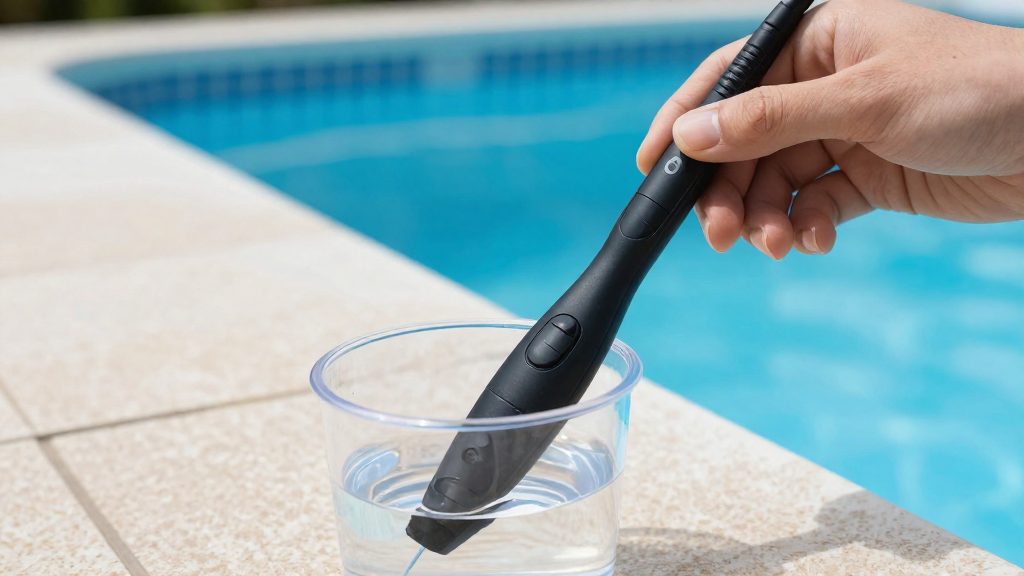
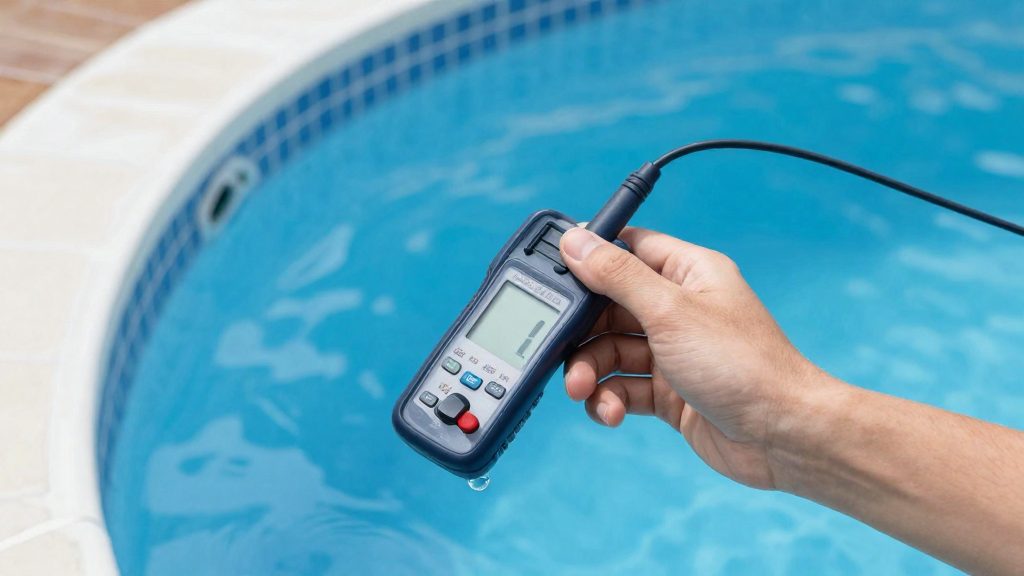
Then measure the pool at regular intervals, such as monthly and at the start and end of the swimming season, and write each result down. The direction over time matters more than one reading, because a single high value can come from a recent chemical dose or a sample taken near the skimmer. Use a meter that suits your pool type and follow the manufacturer’s manual for how to take and store samples.
How do you lower TDS in a pool?
Dilution is the only practical method. You remove part of the pool water and replace it with water that has a lower TDS. The result can be estimated as: new TDS = current TDS × (1 − fraction drained) + fill-water TDS × fraction drained. Draining a larger fraction lowers the reading more, but the outcome is always pulled toward the TDS of the water you add.
Chemicals, shock treatments and filters do not lower TDS, because they either add dissolved material or do not remove it. If your fill water already has a high TDS, such as well water with a high mineral load, dilution will have a limited effect. In that case, test the source first and ask a water-treatment professional about cleaner supply options before planning a drain.
When should you drain and refill?
Partial draining is the usual step when TDS has risen well above your fill-water baseline and other causes have been ruled out. Full draining is rarely needed and carries structural risks, so treat it as a last resort.
Before you drain, check three things. First, read your equipment manufacturer’s manual for any product-specific limits or procedures, including the instructions for your cover, liner and salt chlorine generator if you have one. Second, check your municipal bylaws, because many municipalities restrict where pool water can go, such as storm drains, lawns or septic systems, and some require dechlorination before discharge. Third, if you run a public pool, the Nova Scotia Department of Health and Wellness publishes operational guidelines for aquatic facilities that include a section on pool water quality management, which is the reference to consult for public facilities in that province.
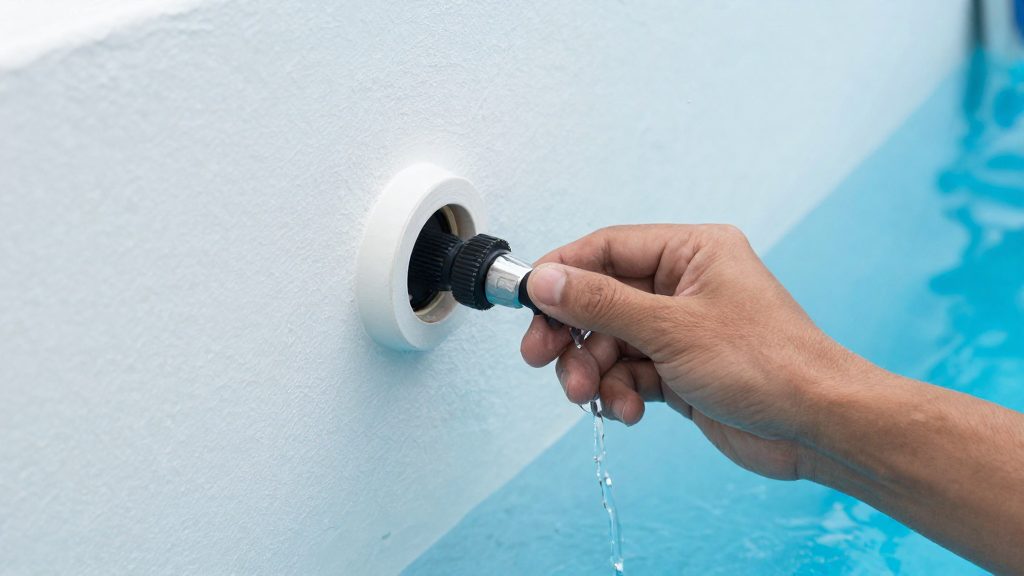
For safety during the work, shut off the pump before the water level drops below the skimmer or return line, so it does not run dry. Use a ground-fault protected circuit for any electrical equipment near the pool. Do not drain an in-ground pool completely unless the manufacturer and a pool professional say it is safe, because an empty pool can be damaged by pressure from groundwater, especially vinyl-lined pools. Once the water is refilled, add chemicals one at a time, never mix them in a bucket, and rebalance pH, alkalinity and sanitizer. Let the water circulate and follow the label before anyone swims.
Does salt change the picture?
Yes. In a salt chlorine generator pool, the salt you add is a major part of the dissolved content, so a reading that would be high for a freshwater pool can be normal for a salt pool. Compare trends against your own baseline and the range given in the generator’s manual, rather than against freshwater guidance. Salt is also removed when you drain, so check the salt level after refilling and add salt as the manual directs.
How can you keep TDS from building up again?
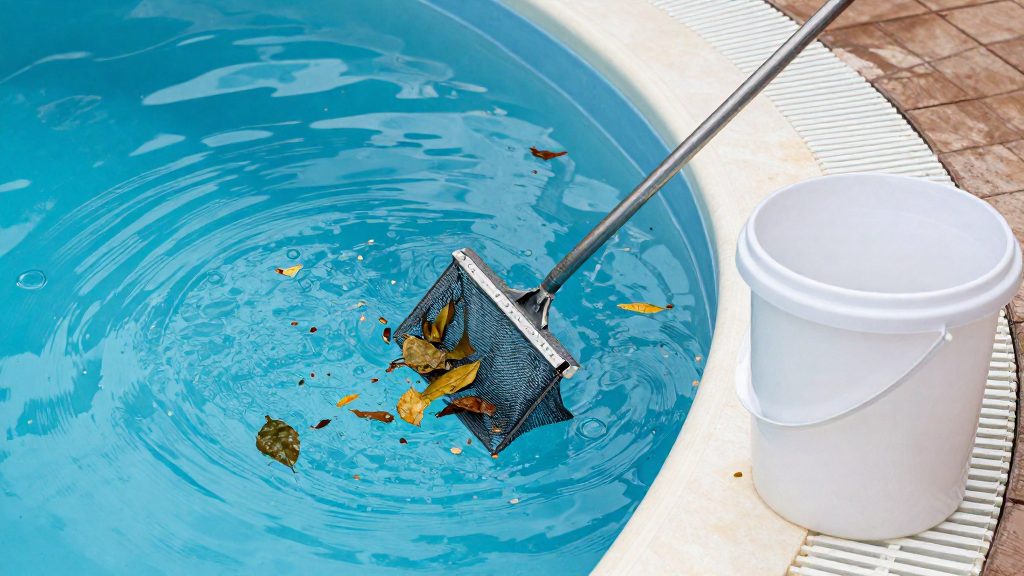
Prevention is cheaper than correction. Keep a cover on the pool when it is not in use, because it cuts evaporation and blocks debris. Ask bathers to shower before entering, which removes oils, sunscreen and cosmetics. Empty the skimmer basket regularly and use a skimmer sock to catch fine debris before it breaks down. Dose chemicals according to test results rather than habit, since each extra dose adds residue. When you top up, use the cleanest water source you have and record its TDS so the baseline stays current.
Frequently asked questions
Is a high TDS reading a reason to stop swimming?
Not on its own. Stop swimming if sanitizer, pH or other readings are outside the range on the product label or the manufacturer’s guidance, or if the water is cloudy or irritating. Correct those readings first, then retest.
Is softened water a good choice for topping up?
Usually not without testing. A water softener exchanges hardness minerals for sodium, which adds dissolved content. Check your softener’s manual and test the water before using it to fill or top up a pool.
Does rainwater help lower TDS?
It can dilute the pool slightly, but rainwater is uncontrolled and can carry debris and airborne contaminants. Test and treat the pool afterwards rather than relying on rain to fix a high reading.