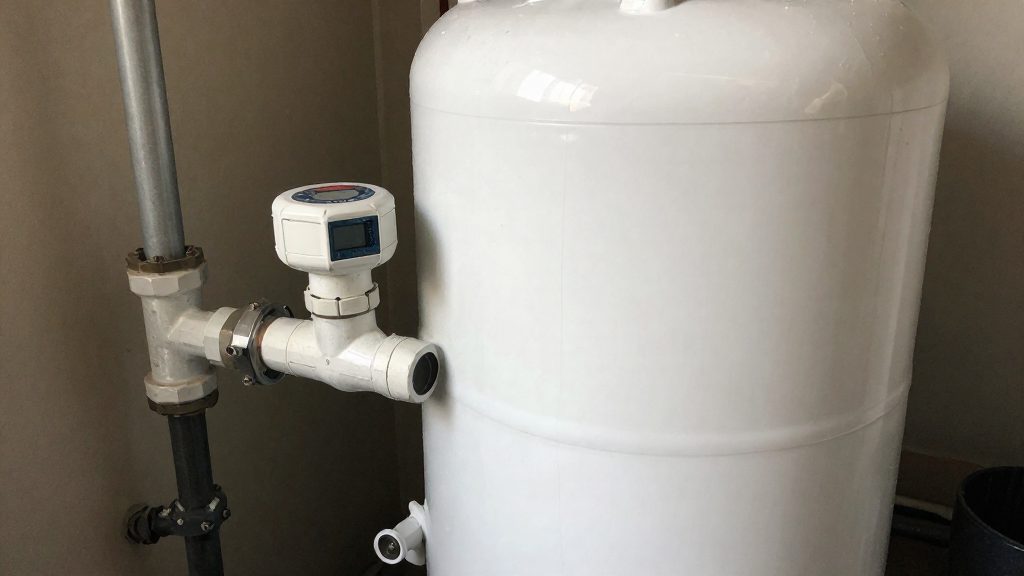
Nitrate in well water becomes a health concern at 45 mg/L, the maximum acceptable concentration (MAC) set by Health Canada, which equals 10 mg/L measured as nitrate-nitrogen. Boiling does not reduce it, and ordinary household filters are not designed to remove it. The residential options named in Health Canada’s guidance are reverse osmosis, ion exchange using a nitrate-selective resin, and distillation, all installed at the point of use. Test through an accredited laboratory first, stop using the water for infant formula until you have results, and choose a device whose nitrate performance is certified.
What nitrate level is too high in well water?
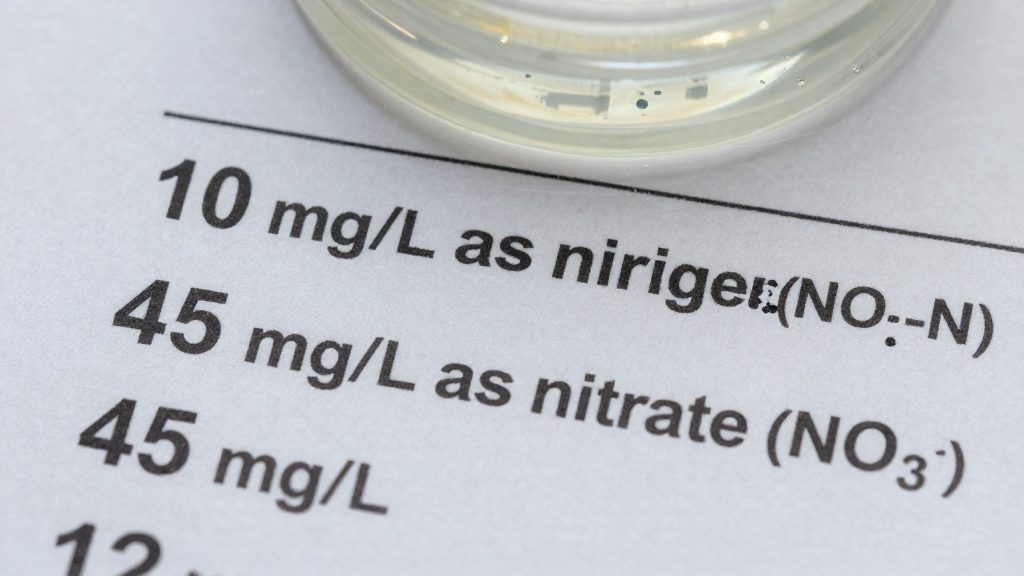
Health Canada sets the MAC for nitrate in drinking water at 45 mg/L, equivalent to 10 mg/L as nitrate-nitrogen. Laboratories report nitrate in one of these two forms, so read the units on your report before comparing it with the guideline. The two values are consistent with a factor of 4.5: multiply a nitrate-nitrogen result by 4.5 to get the nitrate value. The MAC for nitrite is 3 mg/L, or 1 mg/L as nitrite-nitrogen, so ask the laboratory to report both parameters.
Health Canada presents these figures as guidelines. The rules that apply to a private well depend on your province and municipality, so your local public health unit is the right contact for the testing and follow-up that apply where you live.
Why is nitrate in well water a health risk?
The main concern is methemoglobinemia, a blood condition that reduces the blood’s ability to carry oxygen. Health Canada’s technical review links cases to nitrate above 45 mg/L, mostly in infants. Of the 214 clinical cases with available data, none occurred below 45 mg/L. About 2% occurred between 49 and 88 mg/L, and most cases (80%) involved concentrations above 220 mg/L. The guideline is therefore a protective threshold, not a level at which problems are common.
Infants under six months are the most susceptible group. The cases were observed in infants fed formula reconstituted with water high in nitrate, and the review notes that breastfeeding may protect infants under six months. The fetus and people with a genetic deficiency of NADH-cytochrome b5-methemoglobin reductase are also listed as more susceptible.
How do you test your well for nitrate?
Use an accredited laboratory and ask for both nitrate and nitrite results. Follow the sampling instructions the laboratory gives you, because a poorly collected sample can produce a misleading number. Nitrate has no taste or smell, so you cannot detect it with your senses.
Test the source water before buying any device. Health Canada advises this because bacterial contamination often occurs alongside nitrate, and a device that removes nitrate will not solve a bacterial problem. Your public health unit can recommend how often to retest in your area. Retest after events that could change the water, such as flooding, nearby fertilizer or manure spreading, a septic repair, or work on the well itself. A single result is a snapshot, so keep every report together.
Does boiling remove nitrates?
No. Health Canada states that boiling water will not reduce or remove nitrate or nitrite. As water evaporates during boiling, the remaining water becomes more concentrated, so boiling does not make high-nitrate water suitable for formula or drinking.
Which treatments remove nitrate from well water?
Health Canada identifies reverse osmosis, ion exchange and distillation as the relevant residential methods. Each has specific conditions, and conventional treatment does not work. Coagulation, sedimentation, filtration and chlorination, the processes used at municipal plants, are not effective for nitrate removal.
Reverse osmosis is the method most often discussed for homes. Residential reverse osmosis devices can achieve lower treated-water concentrations, and removal depends on the device and on the source level. Certification under NSF/ANSI Standard 58 verifies only that treated water is below 10 mg/L as nitrate-nitrogen (45 mg/L as nitrate). Accredited certification bodies report that 30 to 50% of certified reverse osmosis devices can reach below 5 mg/L as nitrate-nitrogen (22 mg/L as nitrate), so read the manufacturer’s performance claim rather than assuming the lower figure. Reverse osmosis should be installed at the point of use, typically the drinking-water tap, because a whole-house system would need impractically large volumes of feed water. Treated water may be corrosive to plumbing, and pre-treatment can reduce fouling and extend membrane life.
Ion exchange can be a feasible residential option, but it requires careful design. Systems are typically designed by drinking water treatment providers or dealers, and components should be certified to NSF/ANSI Standard 61. The main risk is chromatographic peaking. A standard strong-base anion resin can release nitrate back into treated water when competing ions such as sulphate displace it after breakthrough, so treated water can end up with more nitrate than the source. A nitrate-selective resin prevents this and is strongly recommended for homes. If only standard resin is available and the water contains sulphate, consider another treatment. Treated water must be tested regularly to catch breakthrough.
Distillation may also be available in certified devices. Like reverse osmosis, it should be installed at the point of use because its treated water may be corrosive to plumbing.

Why do standard filters and softeners fall short?
Ordinary activated carbon filters and water softeners are designed for other jobs. A softener removes hardness minerals by exchanging them for sodium, and carbon mainly targets chlorine and many organic compounds. Neither is listed in Health Canada’s guidance as a nitrate method, and the official sources consulted do not specify nitrate removal results for these devices. A softener on a nitrate-contaminated well will therefore leave nitrate in the water. Treat any claim of nitrate removal from these devices as unverified unless the manufacturer’s documentation shows nitrate certification.
How do you choose a certified nitrate system?
Start with the performance claim, not the product name. Health Canada does not endorse specific brands, and it strongly recommends devices certified by an accredited body to the relevant NSF/ANSI standards. Then check the following points:
- the source concentration from your own test, compared with the range the device is certified for, since reverse osmosis performs better at lower source levels;
- the installation point, which for reverse osmosis should be the drinking-water tap;
- the monitoring plan, meaning who tests the treated water, how often, and what result would mean the unit is failing;
- the maintenance schedule, because devices lose removal capacity over time and components must be replaced according to the manufacturer’s stated lifespans;
- for ion exchange, a nitrate-selective resin and a qualified designer.
When should you stop using well water for drinking?
Stop using the water for drinking and cooking if a test shows nitrate above 45 mg/L as nitrate, or above 10 mg/L as nitrate-nitrogen, or nitrite above 3 mg/L. Do not prepare infant formula with that water, even after boiling. Use an alternative supply that meets the guideline until a treatment has been installed and verified by testing.
If a formula-fed infant or a pregnant person has consumed high-nitrate water and shows signs such as bluish or greyish lips or skin, or unusual drowsiness, seek urgent medical care. Bring the test results with you. The official sources consulted do not list symptoms in this context, so do not wait for symptoms to appear before changing your water source.
Why not fix the source instead?
Nitrate often enters groundwater from the surface, including fertilizer, manure and septic systems, and shallow wells are more exposed to these inputs. A deeper well or a relocated intake may draw from a different part of the aquifer, but the outcome depends on local geology and cannot be assumed. A licensed well contractor or a hydrogeologist can assess the options, and any new well or change to the existing one should be followed by a fresh nitrate and nitrite test.
Frequently asked questions
Is a home nitrate test kit enough to make decisions?
A home kit can give a rough screen, but the official sources consulted do not specify its accuracy against guideline values. Use an accredited laboratory result before deciding on treatment or on formula preparation.
Does a nitrate-certified device also remove nitrite?
The official sources consulted do not specify whether the nitrate-certified devices they describe also reduce nitrite. Ask the manufacturer for nitrite data and confirm the result with a retest.
Can I use high-nitrate well water for bathing or washing dishes?
The Health Canada guidance reviewed here focuses on drinking water and formula, and the official sources consulted do not specify guidance for other household uses. Ask your local public health unit, and keep the water away from babies’ bottles and from anything an infant might swallow.
Does treatment need to be checked after installation?
Yes. Treated water should be tested regularly through an accredited laboratory to confirm that the device is working and, for ion exchange, that breakthrough is not occurring.