What Is Total Dissolved Solids (TDS) in Pool Water?
Total Dissolved Solids (TDS) refers to the cumulative sum of all organic and inorganic substances dissolved in your pool water. Measured in parts per million (ppm), these substances are fully dissolved and cannot be trapped by standard mechanical filters.
The composition of TDS generally falls into two categories:
| Substance Type | Examples |
|---|---|
| Inorganic | Minerals such as calcium, magnesium, and sodium chloride |
| Organic | Bather waste, dissolved oils, and chemical residues |
Once TDS reaches a certain action threshold, the water may become saturated, leading to diminished sanitizer efficacy or scale formation. Standard chemical treatments or mechanical filtration (sand, cartridge, or DE) cannot remove these solids.
Why Does Pool TDS Keep Rising Over Time?
TDS increase is a cumulative process. Because dissolved solids bypass standard filtration, they build up over time due to several factors:
- Evaporation: When water evaporates, only pure H2O leaves the pool. Dissolved minerals and salts remain, concentrating the solids in a smaller volume.
- Chemical Accumulation: Stabilizers, pH adjusters, and other maintenance chemicals introduce dissolved substances that stay in the water indefinitely.
- Bather Waste: Swimmers introduce organic matter, skin cells, and cosmetics that break down into dissolved components.
- Fill Water: Source water used for top-offs contains its own baseline of minerals and salts.
| Source of TDS | Primary Mechanism | Result |
|---|---|---|
| Evaporation | Pure water loss | Concentration of existing minerals |
| Chemical Dosing | Addition of salts/stabilizers | Accumulation of dissolved solids |
| Bathers | Introduction of organic matter | Increase in organic load |
| Top-offs | Mineral-heavy source water | Constant addition of new solids |
What Problems Does High TDS Cause in a Pool?
Excessive dissolved solids negatively impact water quality and structural integrity. The primary issue is diminished sanitizer efficacy; as water becomes saturated, chlorine cannot work efficiently, often requiring higher doses to maintain sanitation.
High TDS also leads to visible and structural problems:
- Turbidity: Chronic cloudiness that cannot be resolved with clarifiers.
- Scaling: Excess minerals create rough deposits on plaster and can clog heat exchangers.
- Bather Irritation: High mineral loads can cause stinging eyes and itchy skin.
| Affected Area | Impact of High TDS | Result |
|---|---|---|
| Water Chemistry | Reduced chlorine effectiveness | Poor sanitation |
| Visual Quality | Persistent turbidity | Cloudy water |
| Equipment & Surfaces | Mineral accumulation | Scaling and deposits |
| Bather Comfort | Chemical imbalance | Skin and eye irritation |
How to Test and Measure Pool TDS Accurately
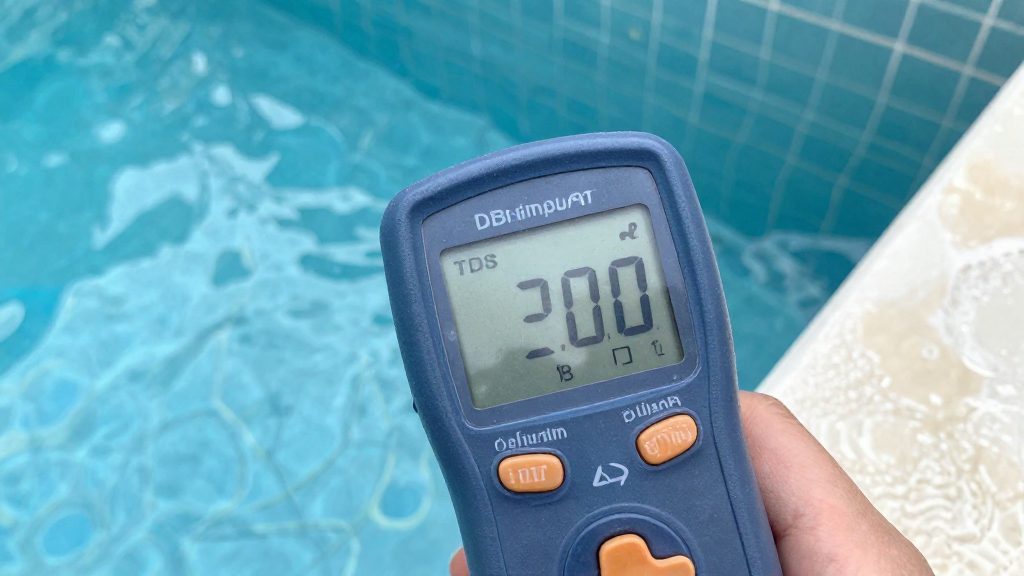
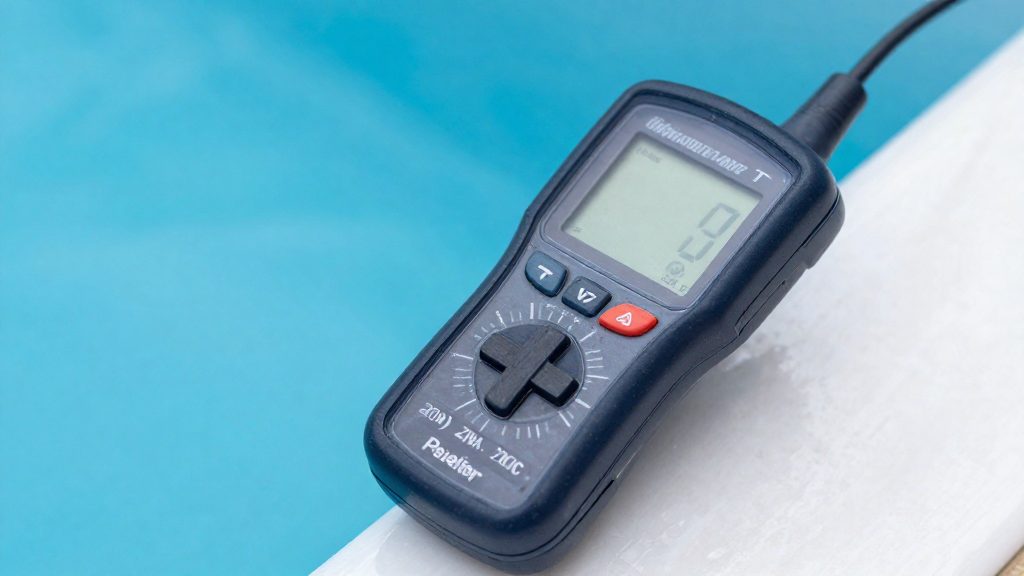
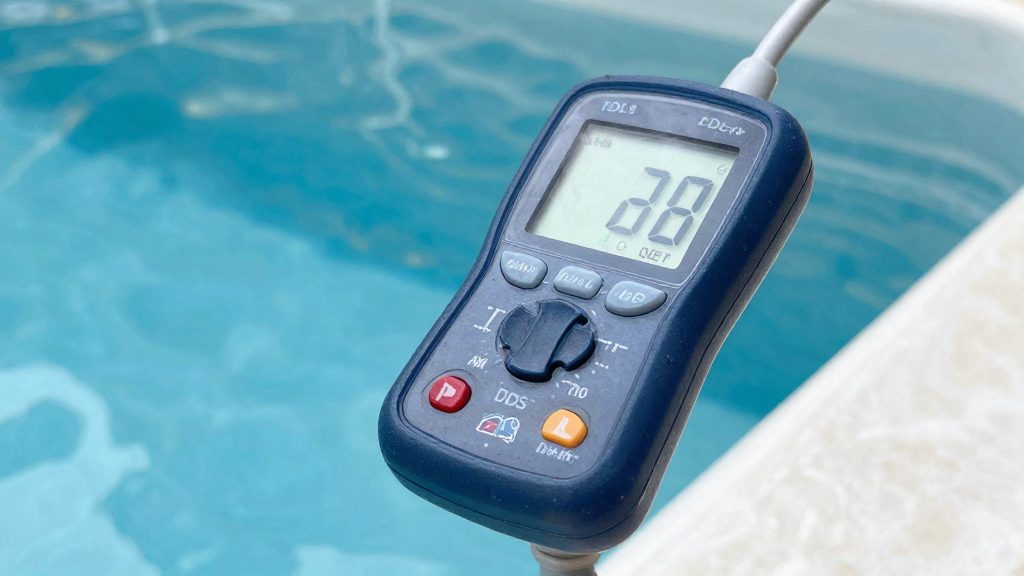
To quantify dissolved substances, use a TDS meter. These handheld electronic devices rely on conductivity measurement; since dissolved salts and minerals conduct electricity, the meter estimates the total dissolved matter and converts it into ppm (parts per million).
To get an accurate reading:
| Step | Action | Purpose |
|---|---|---|
| 1 | Rinse the probe | Remove contaminants from previous tests |
| 2 | Sample away from walls | Avoid concentrated debris or chemical pockets |
| 3 | Submerge the sensor | Ensure the probe is fully immersed |
| 4 | Wait for stability | Allow the digital reading to settle |
How to Lower High TDS in a Swimming Pool
The industry-standard method to reduce TDS is partial draining and dilution. This involves removing mineral-heavy water and replacing it with fresh fill water.
| Step | Action | Purpose |
|---|---|---|
| 1 | Pre-test fill water | Ensure replacement water has low TDS. |
| 2 | Partial drain | Remove a portion of the pool volume. |
| 3 | Fresh refill | Add new water to restore the level. |
| 4 | Re-test | Verify new TDS levels and adjust chemistry. |
Avoid emptying the pool entirely to protect the structural integrity of the shell or liner. Draining too much at once can cause damage from hydrostatic pressure, where groundwater pushes against the structure from the outside.
After refilling, re-balance the water chemistry, as new water introduces different levels of hardness and alkalinity.
Can You Lower TDS Without Draining Your Pool?
While standard filters cannot remove dissolved substances, specialized equipment can. The primary non-drain alternative is mobile reverse osmosis (RO).
This professional service uses a trailer-mounted system to force pool water through a semi-permeable membrane. This process strips away dissolved solids, including calcium hardness and cyanuric acid, which are otherwise impossible to remove without draining. RO is highly efficient, returning a substantial portion of purified water to the pool.
| Feature | Standard Filtration | Mobile Reverse Osmosis (RO) |
|---|---|---|
| Target | Suspended particles | Dissolved solids |
| Removes Calcium | No | Yes |
| Removes Cyanuric Acid | No | Yes |
| Water Loss | Minimal | Low (high recovery rate) |
TDS Management Differences for Saltwater Pools
Saltwater pools require a different perspective due to the sodium chloride baseline necessary for the salt chlorine generator. Because salt is a dissolved solid, these pools naturally operate with a much higher baseline of TDS.
| Pool Type | Normal Operating TDS Range | Common Action Threshold |
|---|---|---|
| Standard Chlorine | Low to Moderate | Lower threshold for draining |
| Saltwater | High | Higher threshold for draining |
A high saltwater TDS range is a functional requirement, not a sign of poor quality. However, if TDS exceeds the specific threshold for saltwater systems, it can lead to scale formation or reduced sanitizer efficacy. In such cases, partial draining and dilution remain the only solution.
Frequently asked questions
Can I use pool chemicals or clarifiers to lower my TDS?
No, dissolved solids cannot be neutralized or removed by adding shock treatments or clarifiers. These substances remain in the water regardless of the chemical treatments applied.
Will my pool filter remove the dissolved solids?
Standard mechanical filters, including sand, cartridge, and DE systems, only capture suspended particles and cannot eliminate dissolved solids. To remove these, you must either dilute the water or use specialized reverse osmosis filtration.
How do I safely reduce high TDS levels in my pool?
The most common method is partial draining and refilling with fresh water. To protect your pool’s structure from hydrostatic pressure, it is recommended to replace only 25% to 50% of the volume at a time.