Why Does Rain Make Pool Water Cloudy?
Rainwater is not pure; it interacts with the atmosphere and your surrounding environment to alter the chemistry of your pool. When precipitation occurs, several factors converge to create water turbidity.
First, rainwater is naturally acidic. This acidity drives down the pH and Total Alkalinity of the pool water. When the pH shifts away from the ideal balance, the efficiency of your sanitizer drops, and the water can lose its crystalline clarity.
Second, heavy rainfall causes sanitizer dilution. As a large volume of fresh water enters the pool, the concentration of Free Available Chlorine is lowered. This reduction makes the water more susceptible to organic contaminants and microscopic growth.
Finally, rain acts as a transport mechanism for external pollutants. Storm runoff washes airborne particulates, dust, and pollen into the water. This organic debris consumes the remaining chlorine and creates suspended colloidal matter. Additionally, runoff from nearby lawns often introduces phosphates from fertilizers, which serve as nutrients that accelerate the growth of algae.
| Trigger | Impact on Pool Water | Result |
|---|---|---|
| Acidic Rain | Lowers pH and Total Alkalinity | Chemical imbalance |
| Precipitation | Dilutes sanitizer concentration | Reduced disinfection |
| Surface Runoff | Introduces phosphates and debris | Organic contamination |
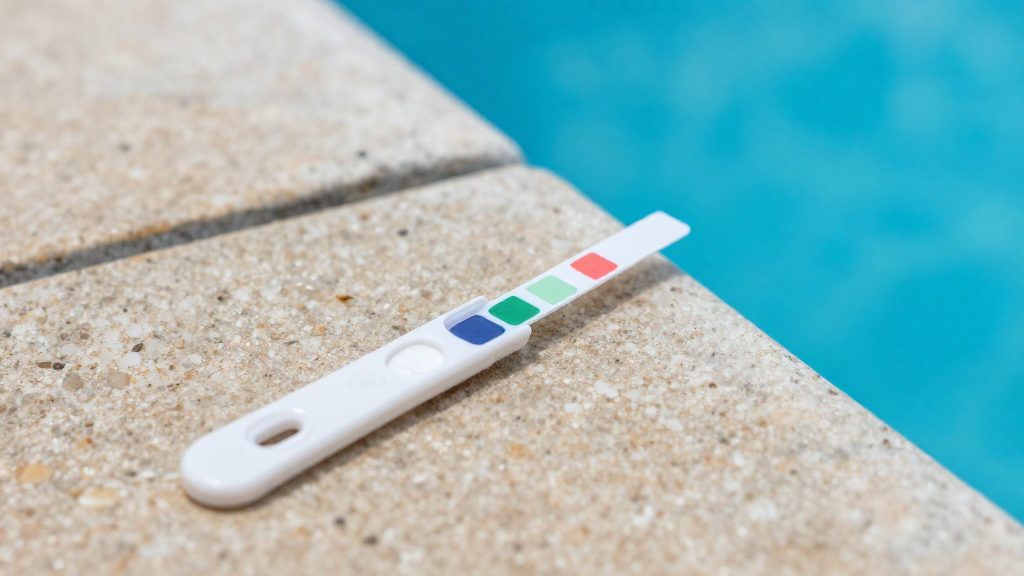
Essential Water Balance Ranges to Check First
When pool water becomes cloudy after rain, the first step is to verify if your chemistry aligns with the benchmarks established by the Pool & Hot Tub Alliance (PHTA).
Before adding any corrective chemicals, test your water to see if these key parameters have shifted:
| Parameter | Target Range | Impact of Rain |
|---|---|---|
| Free Available Chlorine | 2.0 to 4.0 ppm | Diluted by precipitation and consumed by organic debris |
| pH | 7.2 to 7.8 | Driven downward due to the acidity of rainwater |
| Total Alkalinity | 80 to 120 ppm | Often lowered, reducing the water’s ability to resist pH swings |
If your pH falls below the ideal range, the water becomes more acidic, which can cause skin and eye irritation for swimmers and increase the corrosiveness of the water toward plaster and metal equipment. Similarly, a drop in Total Alkalinity makes the pool chemistry unstable, which can contribute to the cloudy appearance. Ensuring these levels are restored to their standard baselines is the necessary foundation for any subsequent filtration or clarification efforts.
Step-by-Step Guide to Clearing Post-Rain Murkiness
To restore clarity after a storm, follow this operational sequence to remove contaminants and stabilize the water.
| Step | Action | Purpose |
|---|---|---|
| 1 | Physical Debris Removal | Clear surface leaves and empty skimmer and pump strainer baskets to ensure optimal hydraulic flow. |
| 2 | Brushing | Scrub the walls and floor to dislodge organic matter and prevent algae attachment. |
| 3 | Sanitizer Restoration | Apply a shock treatment to oxidize organic contaminants and eliminate combined chlorine. |
Start by removing all large debris. Removing these physically reduces the chemical load on your system. Once the surface is clear, brush the entire pool surface. This step is vital because it suspends settled particles, making them available for the filtration system to capture.
Finally, address the sanitizer restoration. You must perform a superchlorination. Using liquid chlorine or calcium hypochlorite will destroy chloramines and neutralize the nutrients introduced by runoff. For the best results, apply this treatment at night to prevent the sun from breaking down the chemicals.
How to Run and Clean Your Filtration System
To eliminate turbidity after a storm, your priority is to maximize the volume of water passing through the filter. The most effective approach is to operate the pool pump and filtration system continuously for 24 hours per day. This constant circulation ensures that suspended organic matter and airborne particulates are processed without interruption until the water returns to full clarity.
Maintaining an unimpeded hydraulic flow is equally important. Debris washed in by rain can quickly clog the system, reducing efficiency. You must regularly empty the skimmer and pump strainer baskets to prevent flow restriction and protect the pump motor from strain.
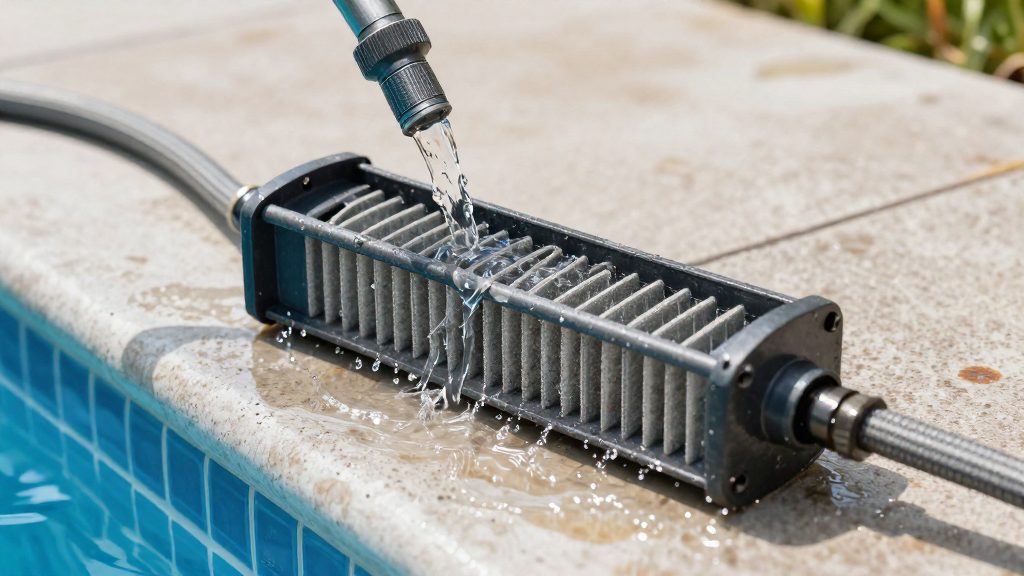
Depending on your filter type, you will need to perform specific maintenance when the pressure gauge indicates a significant rise above the clean baseline operating pressure.
| Filter Type | Cleaning Method | Trigger |
|---|---|---|
| Sand & D.E. | Filter backwashing | Pressure rise above baseline |
| Cartridge | Manual rinsing | Pressure rise above baseline |
Pool Clarifier vs. Flocculant: Which Should You Use?
When rain introduces airborne particulates and organic debris, your pool water may become turbid. To restore clarity, you can use either a clarifier or a flocculant, depending on the severity of the cloudiness and your equipment.
A pool clarifier acts as a polymeric coagulant. It works by aggregating microscopic suspended colloids into larger masses that are own-size enough to be trapped by your existing filtration system. This is the preferred method for mild turbidity where the filter can still handle the load.
In contrast, a pool flocculant is designed for more severe cloudiness. Instead of relying on the filter, it causes all suspended particles to clump together and sink to the bottom of the pool. This creates a layer of sediment that must be vacuumed directly to waste, bypassing the filter entirely to avoid clogging it.
| Feature | Pool Clarifier | Pool Flocculant |
|---|---|---|
| Mechanism | Aggregates particles for filtration | Drops particles to the pool floor |
| Removal Method | Standard filter cycle | Vacuum to waste |
| Best Use Case | Mild cloudiness | Heavy turbidity |
| Filter Impact | Traps debris in filter media | Bypasses filter media |
Choosing between the two depends on the turbidity level. If the water is slightly hazy, a clarifier is the most convenient option. If the water is thick or heavily clouded after a storm, a flocculant provides a faster path to clarity by removing the matter physically from the pool.
Can You Safely Swim in a Cloudy Pool After Rain?
Swimming in a pool that has become cloudy after a storm is generally not recommended until the water is properly treated. The cloudiness is often a visual indicator that the water chemistry has been compromised, posing several health and safety risks.
First, heavy rainfall dilutes the sanitizer concentration. When the level of free available chlorine drops, the water loses its ability to neutralize bacteria and other microorganisms. This creates an environment where pathogen proliferation can occur, increasing the risk of skin irritations or waterborne illnesses.
Beyond chemical concerns, turbidity creates a significant visibility hazard. If the water is cloudy enough that you cannot clearly see the main drain at the bottom of the pool, swimming becomes dangerous. Poor visibility hides underwater obstacles and prevents lifeguards or parents from seeing swimmers in distress.
| Risk Factor | Impact of Rain | Safety Concern |
|---|---|---|
| Sanitizer Levels | Dilution of chlorine | Bacterial growth |
| Water Clarity | Suspended particulates | Poor visibility of pool floor |
| Organic Load | Introduction of phosphates | Rapid algae development |
How Can You Prevent Cloudiness Before Storms Hit?
Taking proactive steps before a storm arrives can significantly reduce the likelihood of pool water cloudy after rain. By preparing your water chemistry and environment, you minimize the organic load that typically triggers turbidity.
Sanitizer boosting is one of the most effective preventative measures. Increasing your free chlorine levels before the rain starts provides a buffer. This ensures that when organic debris and airborne particulates are washed into the water, there is enough available chlorine to oxidize them immediately rather than allowing them to linger as suspended matter.
Managing nutrients is equally important. Rainwater and deck runoff often carry phosphates from lawn fertilizers and decaying vegetation into the pool. Because phosphates act as a food source for algae, using a phosphate remover before a storm can starve potential algae blooms, preventing the green-tinted cloudiness that often follows heavy rain.
Finally, address the physical environment to mitigate runoff. Clearing the area around the pool deck of loose leaves and organic debris prevents these materials from being swept into the water.
| Preventative Action | Primary Goal | Benefit |
|---|---|---|
| Pre-storm Shocking | Boost Sanitizer | Neutralizes organic contaminants faster |
| Phosphate Reduction | Nutrient Control | Inhibits algae growth from runoff |
| Deck Clearing | Debris Mitigation | Reduces the volume of organic matter entering the pool |
Frequently asked questions
Why did my pool turn cloudy after a storm?
Rainwater is naturally acidic and introduces organic debris and phosphates into the water. This combination disrupts the chemical balance and lowers the sanitizer concentration, leading to turbidity.
How do I clear the water after heavy rain?
You should remove physical debris, balance the chemistry, and run your filtration system continuously for 24 hours. If the water remains cloudy, a shock treatment can help oxidize remaining contaminants.
Can I swim in my pool immediately after it rains?
It is safer to wait until the Free Available Chlorine is back within the 1.0–4.0 ppm range and the water is clear. Ensure the pool floor is visible and the chemistry is balanced before entering.