When Should You Open and Balance Your Pool in Spring?
Timing the opening of your pool is a matter of balancing ambient weather conditions with chemical reactivity. The primary goal is to ensure that your sanitizers can effectively control the water before biological growth takes hold.
The recommended window for opening and balancing your pool is when consistent daytime ambient temperatures reach the threshold of 65°F–70°F. Opening the pool too early, when temperatures are still fluctuating or too low, can be counterproductive. Conversely, waiting too long into the warmer months increases the risk of a rapid algae bloom, as organic matter and warmth provide the ideal environment for proliferation before your sanitizers have reached full effectiveness.
By aligning your opening schedule with these temperature markers, you ensure that the water is warm enough for chemicals to react efficiently while remaining cool enough to keep algae growth manageable. Once this temperature threshold is met, you can proceed with your testing and dosing sequence to stabilize the water for the season.
Pre-Balancing Preparations: Filtration and Water Level
Before initiating chemical tests for your open pool spring water balance, you must establish the correct physical and mechanical conditions. Attempting to balance water that is stagnant or improperly leveled will lead to inaccurate readings and inefficient chemical distribution.
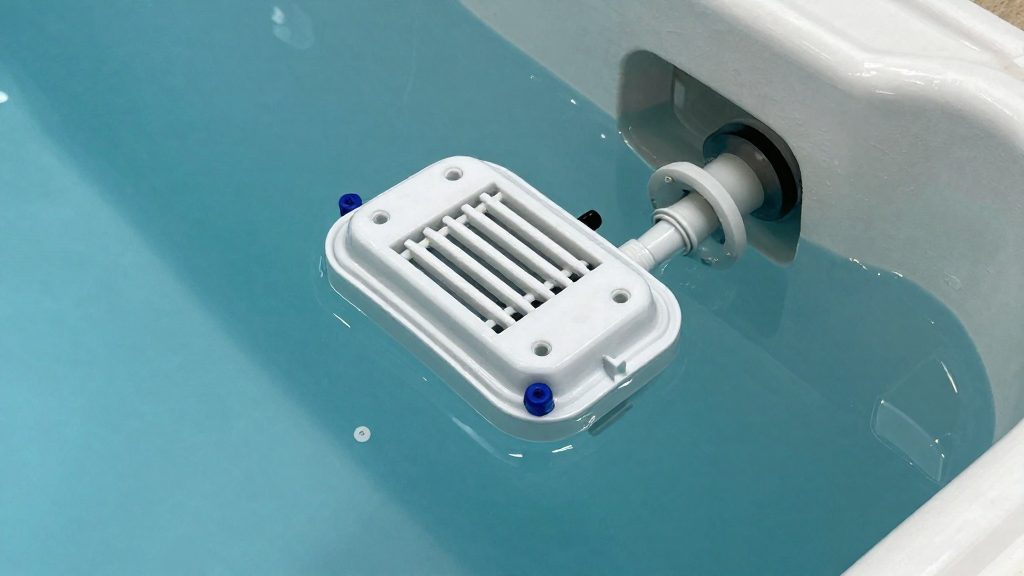
First, verify the water level. Ensure the water reaches midway up the skimmer mouth. Maintaining this height is essential before activating the pump to ensure a proper prime and to prevent cavitation, which can damage the equipment.
Once the water level is restored, activate the filtration system. To achieve a homogeneous mix of the water layers that have remained stagnant over the winter, the pump should run continuously for a period of one to two days. This process eliminates “dead zones” in the pool, ensuring that the same water quality is present at the surface as at the bottom.
| Preparation Step | Action | Purpose |
|---|---|---|
| Water Level | Fill to midway up the skimmer mouth | Maintain pump prime and prevent cavitation |
| Pump Activation | Start the circulation system | Initiate water movement |
| Filtration Run | Continuous operation for 24 to 48 hours | Ensure homogeneous mixing of water layers |
What Is the Correct Order to Balance Pool Chemicals?
Achieving a stable environment for your open pool spring water balance requires a strict sequential hierarchy. Adding chemicals in a random order often leads to “pH bounce,” where one adjustment inadvertently shifts another parameter, forcing you to repeat the process and waste product.
The logic behind the sequence is based on chemical buffering. You must first establish a stable base that prevents the pH from fluctuating wildly before you can fine-tune the acidity or introduce sanitizers.
The following table outlines the mandatory order of operations for balancing your water:
| Step | Parameter | Purpose |
|---|---|---|
| 1 | Total Alkalinity | Establishes the acid buffer to stabilize pH |
| 2 | pH | Optimizes sanitizer efficacy and bather comfort |
| 3 | Calcium Hardness | Protects pool surfaces from corrosion or scaling |
| 4 | Cyanuric Acid | Protects chlorine from UV degradation |
| 5 | Shock Treatment | Eliminates contaminants and organic matter |
Following this chemical sequence ensures that each adjustment remains permanent. For instance, adjusting pH before Total Alkalinity is often futile, as the alkalinity level directly influences how the pH reacts to changes. Once the water is chemically balanced and stabilized, you can safely proceed to the final step of shock chlorination to sanitize the water for the season.
How to Adjust Total Alkalinity and pH
To stabilize the acid buffer and prevent pH fluctuations, you must follow a strict sequence: adjust Total Alkalinity (TA) first, followed by pH. This order ensures that the water remains stable and that subsequent pH corrections are not undone by an unbalanced TA.
Adjusting Total Alkalinity
Total Alkalinity acts as a shield for your pH levels. If your TA is too low, the pH will drift rapidly; if it is too high, the pH becomes difficult to move.
- To raise TA: Add sodium bicarbonate (baking soda).
- To lower TA: Use liquid muriatic acid or sodium bisulfate (dry acid).
Adjusting pH
Once the TA is stabilized, you can refine the pH to ensure chlorine efficacy and protect the pool surface from scaling or etching.
- To raise pH: Add sodium carbonate (soda ash).
- To lower pH: Use muriatic acid or sodium bisulfate.
| Parameter | Target Range | Product to Increase | Product to Decrease |
|---|---|---|---|
| Total Alkalinity | 80 to 120 ppm | Sodium bicarbonate | Muriatic acid / Sodium bisulfate |
| pH | 7.2 to 7.6 | Sodium carbonate | Muriatic acid / Sodium bisulfate |
Managing Calcium Hardness and Cyanuric Acid
Once alkalinity and pH are stabilized, you must address the mineral content and stabilizer levels to protect the pool structure and the efficiency of your sanitizers.
Calcium Hardness is essential for protecting the pool surface. In plaster or gunite pools, maintaining a balanced level prevents the water from becoming aggressive, which can lead to plaster etching. Conversely, excessively high levels can cause calcium scaling on the walls and inside the filtration equipment. If levels are too low, you can add calcium chloride. However, if the water is over-saturated with calcium, the only effective remedy is partial drainage and dilution with fresh water.
Simultaneously, you must manage the Cyanuric Acid concentration. This chemical acts as a stabilizer, protecting free chlorine from being rapidly destroyed by ultraviolet rays from the sun. Without sufficient stabilizer, your sanitizer will evaporate quickly, leaving the water unprotected.
| Component | Primary Role | Correction Method |
|---|---|---|
| Calcium Hardness | Prevents surface etching and scaling | Add calcium chloride or partial drainage |
| Cyanuric Acid | Protects chlorine from UV degradation | Add stabilizer (CYA) |
By optimizing these two factors, you ensure the water longevity of your open pool and maintain a consistent chemical barrier against contaminants throughout the season.
Spring Shocking and Sanitizer Maintenance
Once the water chemistry is balanced, the final step is to eliminate organic contaminants and establish a stable sanitizer baseline. This process involves shock chlorination, which raises the chlorine level to a point where it can oxidize combined chlorines and destroy dormant algae or bacteria that accumulated during the off-season.
To achieve this, use unstabilized liquid chlorine or calcium hypochlorite. The goal is to reach breakpoint chlorination, ensuring that the free available chlorine is high enough to neutralize all chloramines. To prevent the sun from degrading the chemicals through photolysis, always apply shock treatments in the evening or at night.
After the initial shock treatment, the focus shifts to maintaining a consistent sanitizer baseline. This ensures the water remains safe for swimmers and prevents rapid algae blooms as temperatures rise.
| Phase | Primary Objective | Recommended Product Type |
|---|---|---|
| Shocking | Oxidation of contaminants | Liquid chlorine or Cal-hypo |
| Maintenance | Sustained disinfection | Stabilized chlorine or Salt system |
Once the shock cycle is complete, monitor the free available chlorine levels to ensure they remain within the operational range. This baseline protection, combined with the previously adjusted stabilizer levels, provides a continuous defense against organic growth throughout the swimming season.
Frequently asked questions
When is the best time to open my pool for the season?
You should open your pool when daytime ambient temperatures consistently stay between 65°F and 70°F. This timing ensures chemicals react efficiently while preventing a sudden algae bloom.
Can I test the water immediately after turning on the pump?
No, you must run the filtration system for 24 to 48 hours first. This process ensures that stagnant water layers are mixed homogeneously for accurate chemical readings.
What is the correct order for balancing spring water?
You must follow a specific testing sequence: start with Total Alkalinity, then pH, Calcium Hardness, Cyanuric Acid, and finally shock chlorination.